Mar 23, 2026
Dental Bone Graft Surgery: Cost, Recovery & When You Need It for Implants in NJ
You've been thinking about getting dental implants to replace your missing teeth. You've done your research. You're excited about the possibility of having a permanent solution that looks and feels completely natural. Then you go in for your consultation, and the dentist tells you that you need a bone graft before you can get implants. Your heart sinks. What does that mean? How much is this going to cost? How long will it take? Will it hurt?
If this scenario sounds familiar, you're not alone. Bone grafting is one of the most common procedures patients discover they need when pursuing dental implants, and it's also one of the biggest sources of confusion and hesitation. The good news is that dental bone grafts are extremely common, highly successful, and absolutely worth doing if you want implants that will last for decades. At Veda Family Dentistry in West New York, Dr. Moosavi has performed hundreds of bone graft procedures using advanced 3D CBCT imaging to ensure precision and predictable outcomes.
In this comprehensive guide, we'll explain exactly what a bone graft is, why you might need one, what materials are available, what the procedure actually involves, and what to expect during recovery. We'll also break down the costs, discuss financing options, and share real patient stories from people who discovered that a bone graft was the key to achieving their implant dreams. By the end of this guide, you'll understand why a bone graft isn't a setback, it's actually a bridge to long-term success.
Why Bone Grafts Are Necessary: Understanding Jaw Bone Loss
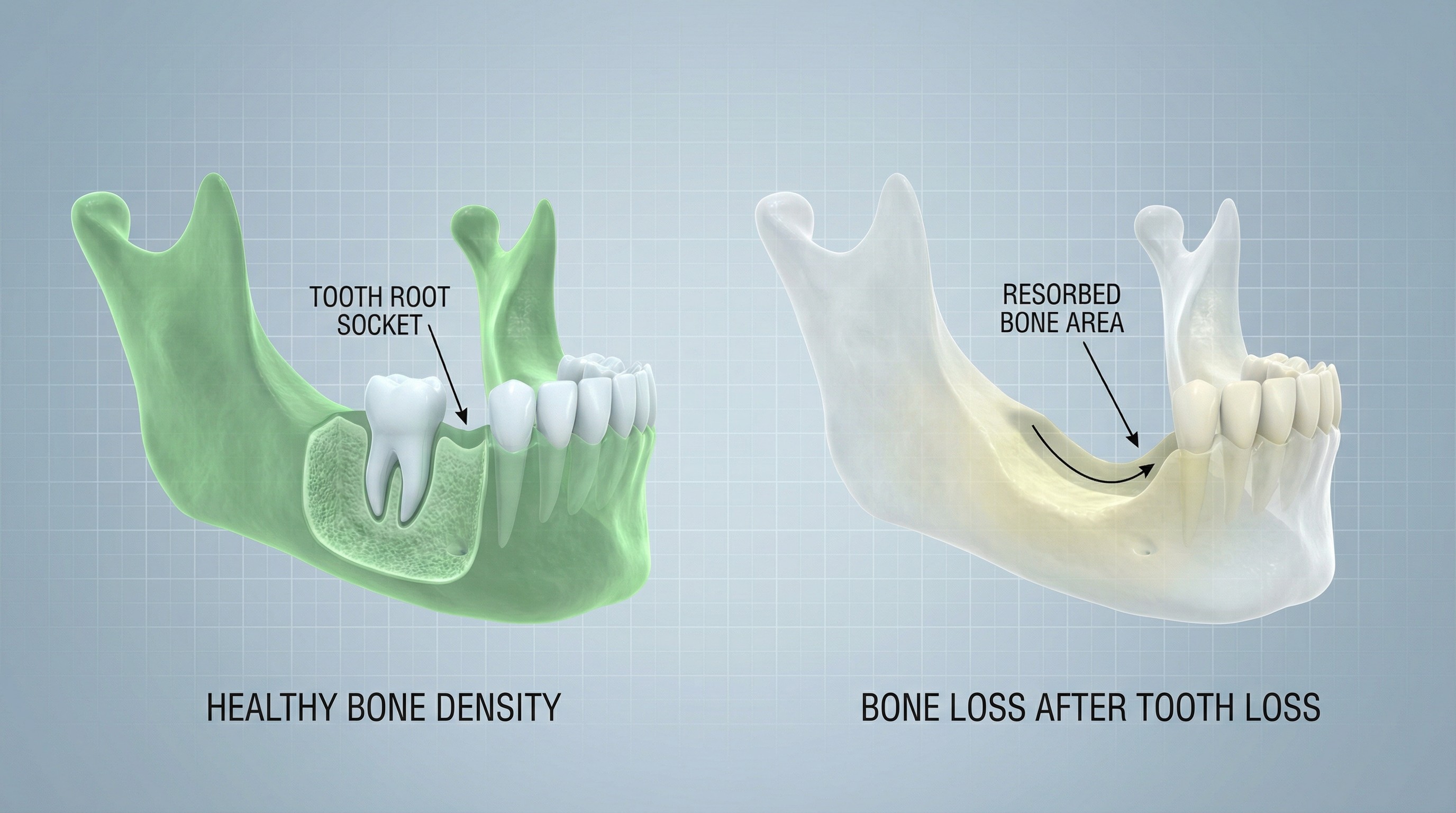
Here's something most people don't realize: your jawbone needs stimulation to stay healthy and maintain its density. That stimulation comes from the roots of your teeth. When you lose a tooth, you lose that stimulation, and your body begins to absorb the bone in that area. This process is called resorption, and it happens automatically and constantly after tooth loss. Within the first year of losing a tooth, you can lose up to 25 percent of the bone width in that area. After that, you continue to lose bone at a slower rate, but the loss continues indefinitely.
This bone loss creates a problem for implants. Dental implants need a certain amount of bone height and width to be anchored securely. If your jawbone has resorbed too much, there isn't enough bone to support an implant. That's where a bone graft comes in. A bone graft provides additional bone material to build up the area where you want to place an implant, restoring the bone to a level where implant placement becomes possible.
Common Causes of Jawbone Loss
Bone loss doesn't just happen to people who've lost teeth recently. There are several reasons why your jawbone might not have enough bone for implants, even if you've had healthy teeth your whole life.
Tooth Loss
This is the most common cause. Whether you lost your tooth due to injury, decay, or gum disease, the underlying bone begins to resorb immediately. The longer the tooth has been missing, the more bone loss you'll typically have. Some patients come to us having lost a tooth 10 or 20 years ago, only to discover that significant bone loss has occurred in the meantime.
Gum Disease
Advanced gum disease (periodontitis) doesn't just damage your gums. It also destroys the bone that supports your teeth. Patients who've had severe gum disease often have compromised bone levels even if they've managed to save some of their natural teeth. This is one reason why treating gum disease early is so important. The earlier you address it, the more bone you can preserve. If you're concerned about gum disease, our gum disease treatment services can help.
Age and Bone Density
As we age, our bone density naturally decreases. This happens faster in some people than others, depending on genetics, diet, hormonal factors, and overall health. Post-menopausal women are particularly susceptible to rapid bone loss due to hormonal changes. According to the National Institute of Health, bone loss accelerates significantly with age, which is why older patients more frequently need bone grafts for implant placement.
Severe Bite Problems or Jaw Trauma
If you've had significant bite problems or trauma to your jaw, bone resorption might have already occurred in certain areas. Similarly, orthodontic problems left untreated for years can sometimes lead to bone loss in specific areas.
How You'll Know You Need a Bone Graft
You won't know for sure whether you need a bone graft until you have a proper evaluation with imaging. That's why Dr. Moosavi always uses 3D CBCT scans during the implant planning process. These scans show him exactly how much bone height and width you have in each area where you're considering placing an implant. If the measurements fall below what's needed for secure implant placement, he'll recommend a bone graft. The specific measurements needed depend on the type of implant you're getting and where it's being placed, but Dr. Moosavi will explain exactly what he sees and why a graft is necessary if that's the case.
Types of Bone Graft Materials: Which One Is Right for You?
One of the first decisions you'll make about your bone graft is what type of material to use. There are actually several options, each with different advantages and disadvantages. Dr. Moosavi will recommend the option that's best for your specific situation, but it's helpful to understand what's available.
Autograft: Your Own Bone
An autograft uses bone taken from your own body. This is typically harvested from inside your mouth (intraoral autograft), usually from the back of your lower jaw or from the roof of your mouth. In some cases, especially when a larger graft is needed, bone might be taken from your hip or tibia (shin bone), but this requires a separate surgical site and is less common.
The advantage of autografts is that they have the highest success rate because your body immediately recognizes the bone as "you" and integrates it seamlessly. There's no risk of rejection or allergic reaction. The disadvantage is that it requires an additional surgical site, which means additional recovery time and discomfort in the donor area. Autografts also have limited availability if you need a large graft, since there's only so much bone you can safely harvest from your own body.
Allograft: Cadaver Bone
An allograft uses bone from a human donor, typically someone who has donated their body to science or medical research. The bone is carefully processed, sterilized, and tested to ensure safety. Don't worry, allografts undergo rigorous screening for disease and are extremely safe.
Allografts have several advantages. They don't require a second surgical site, so your recovery is simpler and there's no pain in a donor area. They're available in larger quantities if you need a bigger graft. They're also typically less expensive than autografts. The disadvantage is a slightly lower success rate compared to autografts, because your body may take longer to integrate the foreign bone. However, modern processing techniques have dramatically improved allograft success rates, and they're now considered an excellent option by most oral surgeons.
Xenograft: Animal-Derived Bone
A xenograft uses bone from an animal source, typically bovine (cow) bone. Like allografts, xenograft material is carefully processed and sterilized. The bone is demineralized and treated to remove the cellular material, leaving behind the bone structure that acts as a scaffold for your own bone to grow into.
Xenografts have the advantage of being available in unlimited supply, they don't carry disease transmission risk, and they're often the least expensive option. The disadvantage is that integration can take longer than with autografts or allografts, and the success rate is slightly lower. However, xenografts are still very effective, especially when combined with other regenerative techniques.
Synthetic Bone Substitutes
Synthetic bone substitutes are manufactured materials designed to mimic natural bone. They might be made from ceramics, polymers, or composite materials. These are newer options that are becoming increasingly popular because they're consistent in quality, available in any quantity needed, and there's no disease transmission risk.
The advantage of synthetic bone is that they're reliable, abundant, and often less expensive than natural bone options. The disadvantage is that they integrate more slowly than natural bone, and success rates can be slightly lower. However, newer synthetic materials are constantly being developed, and some of the newer options are showing results that rival natural bone grafts.
Which Material Does Dr. Moosavi Recommend?
Dr. Moosavi will recommend the material that gives you the best chance of success based on the size of your graft, your health history, your timeline, and your budget. For many patients, he recommends a combination approach: using autograft (your own bone) mixed with allograft or synthetic material. This combines the advantages of both: your own bone provides the most biologically active material for healing, while the additional material increases the overall volume of the graft.
The Bone Graft Procedure: Step-by-Step
Understanding what's actually going to happen during your bone graft procedure can significantly reduce anxiety. Here's what you can expect.
Before the Surgery: Planning and Preparation
The planning stage is crucial. Dr. Moosavi uses 3D CBCT imaging to create a detailed map of your jawbone, showing exactly where the bone loss is and how much bone needs to be added. He'll also take measurements to determine the exact size and shape of the graft needed. This meticulous planning ensures that the graft is placed in exactly the right location for your future implant.
Before your surgery, Dr. Moosavi will discuss the procedure in detail, answer all your questions, and make sure you're prepared. He'll give you pre-operative instructions, which typically include avoiding certain foods, medications, and activities for a few days before surgery. Most patients are asked to avoid aspirin and other blood thinners for about a week before the procedure.
The Day of Surgery: What to Expect
On the day of your surgery, you'll arrive at Veda Family Dentistry and be taken to our surgical suite. Dr. Moosavi will review the plan one more time and answer any last-minute questions. You'll be given local anesthesia to numb the area where the surgery will take place. Depending on the extent of the procedure and your comfort level, nitrous oxide (laughing gas) or IV sedation might also be offered to help you relax.
Once the area is numb, you won't feel pain, though you might feel pressure or vibration as Dr. Moosavi works. He'll make a small incision in your gum to access the area where the bone graft needs to go. If he's using your own bone from inside your mouth, he'll harvest that first, then place it in the graft site. He'll also place the additional bone material (whether allograft, xenograft, or synthetic) and possibly a membrane to contain everything in place. Finally, he'll close the incision with sutures.
The entire procedure typically takes 60 to 90 minutes, depending on the size and complexity of the graft.
Why Dr. Moosavi's 3D CBCT Approach Is Different
What sets Dr. Moosavi apart is his use of advanced 3D imaging throughout the procedure. Rather than relying on two-dimensional X-rays, he can see exactly how much bone he's building and in what exact location. This precision means better results and fewer complications. He's not just going by feel or experience. He's using technology to ensure accuracy that would have been impossible even a decade ago.
Recovery: What Happens in the Days and Weeks After
Bone graft recovery is surprisingly straightforward for most patients, though you do need to follow post-operative instructions carefully to ensure the graft integrates properly.
The First 24 Hours
Immediately after the procedure, you'll likely feel numb from the anesthesia, but as it wears off, you might experience some discomfort. This is completely normal and manageable with over-the-counter pain medication like ibuprofen or acetaminophen. Some swelling and bruising is also normal and typically peaks around day 2 or 3, then gradually improves. You'll want to rest for the remainder of the day and avoid strenuous activity.
Days 2 to 7
By day 2, you can usually return to light activities, though you should continue to avoid anything strenuous. No heavy lifting, intense exercise, or contact sports for at least a week. Your mouth will likely feel sore, and eating soft foods is important. Think soups, smoothies, scrambled eggs, mashed potatoes, and yogurt. Avoid anything hard, crunchy, hot, or spicy. You'll also need to be very careful around the surgical site when brushing your teeth, or you might just rinse gently with salt water instead.
One important thing: you'll probably be prescribed antibiotics to prevent infection. It's crucial that you take the full course, even if you feel fine. Infection is the main thing that could compromise your graft.
Weeks 2 to 4
After about two weeks, you'll likely have your sutures removed, and you'll feel noticeably better. Discomfort should be minimal, and you can gradually return to normal activities. However, you should still avoid strenuous exercise and heavy lifting for at least 4 weeks. This is because your body is actively building new bone, and vigorous activity can disrupt the healing process.
Months 2 to 6: The Critical Integration Period
This is the most important phase, though it's also the most invisible. Your body is integrating the graft material, building new blood vessels, and creating new bone. You won't be able to see this happening, but it's critical that you don't disrupt it. Continue to avoid strenuous activity, protect the surgical area, and follow any post-operative instructions Dr. Moosavi gives you.
During this phase, you might have follow-up appointments with Dr. Moosavi to monitor healing. He might take periodic X-rays or CBCT scans to see how well the bone is integrating.
The Full Timeline: When Can You Get Your Implant?
This is the question every patient asks: how long until I can get my implant? The answer depends on several factors, including the size of the graft, the type of material used, and your body's healing capacity. In general:
Smaller grafts (under 3mm) might integrate in 4 to 6 months. Larger grafts typically take 6 to 12 months to fully integrate. Some patients can get implants after 4 months; others need to wait closer to 12 months. Dr. Moosavi will take follow-up imaging to determine when the bone has integrated enough to safely place an implant. There's no point in rushing this. Trying to place an implant before the bone is ready is a recipe for failure. A little patience now means a successful implant that could last for decades.

Bone Graft Costs and Financing Options
Let's talk about the elephant in the room: cost. Yes, bone grafts add to the total cost of implant treatment, but they're an investment in the longevity and success of your implants.
Breaking Down the Costs
A typical dental bone graft in New Jersey ranges from $500 to $3,000, depending on several factors. The size of the graft is the biggest factor. A small graft to build up a specific area might cost $500 to $1,000. A larger graft that spans multiple teeth might cost $2,000 to $3,000. The type of material also affects cost. Synthetic materials are often the least expensive. Allografts are mid-range. Autografts are typically the most expensive because they require harvesting bone from another site in your mouth.
At Veda Family Dentistry, Dr. Moosavi is transparent about costs. You'll know exactly what you're paying for before you commit to the procedure. Insurance sometimes covers a portion of bone graft costs, especially if it's deemed medically necessary for implant placement, though coverage varies widely by plan.
Real Cost Example
Let's say you're missing one tooth and need a bone graft to support an implant. The bone graft might cost $1,200. The implant placement might cost $1,800. The crown on top might cost $1,500. Total cost for tooth replacement: roughly $4,500. Compare that to the cost of a bridge (which requires grinding down healthy adjacent teeth) at $3,000 to $5,000, or a denture at $1,500 to $3,000. When you factor in the superior longevity and functionality of implants, the slightly higher upfront cost is often worth it.
Financing Your Bone Graft and Implant
We understand that the total cost of implant treatment can feel overwhelming. That's why Veda Family Dentistry offers multiple financing options:
Insurance Coverage
Many dental insurance plans cover a portion of bone graft costs, especially if they're deemed medically necessary. Our billing team will verify your coverage and maximize your benefits. We'll also handle all pre-authorization paperwork, so you don't have to navigate that yourself.
CareCredit
CareCredit is a medical credit card that allows you to make purchases with 0% APR for qualified purchases. If you're approved, you can pay your bone graft and implant costs over 12, 18, or 24 months with no interest, as long as you pay off the full balance during the promotional period. CareCredit often approves patients with less-than-perfect credit, making it a great option for people who don't qualify for traditional financing.
In-House Payment Plans
Veda Family Dentistry also offers our own payment plans. You can spread your costs over several months with flexible payment arrangements. No credit check required. No interest if you pay on time. Just an honest conversation about what works for your budget.
Phased Treatment Approach
If cost is a real barrier, you can sometimes do a phased approach. For example, if you're missing multiple teeth, you might do a bone graft and implant for one tooth first, see how it goes, and then do additional implants over time. This spreads the cost over a longer period and lets you evaluate the results before committing to more treatment.
Risks and Complications: What Could Go Wrong?
Let's be honest: every surgical procedure carries some risk. That said, bone graft complications are relatively rare, especially when performed by an experienced surgeon like Dr. Moosavi. Here's what you should know.
Infection
This is the most common complication, but it's also preventable. If you take your prescribed antibiotics, follow post-operative instructions, and keep the surgical site clean, your infection risk is very low. If infection does occur, it's typically caught early during your follow-up appointments and treated quickly with additional antibiotics or, in rare cases, surgical intervention.
Graft Failure
In rare cases, the graft material doesn't integrate properly and the bone doesn't grow as expected. Studies show that graft failure rates are typically 5 to 15 percent, depending on the type of material and the skill of the surgeon. If your graft fails, you can usually try again with different material or technique. The fact that it failed the first time doesn't mean it will fail the second time.
According to research from the Journal of the American Dental Association, success rates for bone grafts are highest (95%+) when performed by experienced surgeons using modern techniques and materials.
Swelling and Bruising
This isn't really a complication, just a normal part of healing. You'll likely have some swelling and bruising, especially around day 2 or 3. This is completely normal and manageable. Ice therapy during the first 24 hours and heat therapy after that can help minimize swelling.
Nerve or Sinus Issues
Very rarely, a bone graft procedure near the upper jaw can affect the sinus or a nerve. This is why Dr. Moosavi's 3D imaging is so valuable. He can see exactly where nerves and sinuses are located and work carefully around them. When complications do occur (very rarely), they're usually temporary and resolve within weeks or months.
Cost Overruns
This isn't a medical complication, but it's a practical concern. If your graft fails and you need a second graft, that's additional cost. However, with modern techniques and experienced surgeons, graft failure is rare. And when it does happen, it's usually covered under your agreement with your surgeon, meaning you only pay once.
Real Patient Stories: From "Not a Candidate" to Successful Implants
The best way to understand the reality of bone grafts is to hear from people who've been through it.
Michael's Story: The 10-Year Gap
Michael lost a tooth in a car accident 10 years before coming to Veda Family Dentistry. He'd just lived with the gap, assuming implants were too expensive. When he finally came in for an evaluation, X-rays showed significant bone loss in the area. Dr. Moosavi explained that he'd need a bone graft before an implant was possible. Michael was disappointed at first, but once he understood the process and the costs, he decided to move forward. Six months after his bone graft, he got his implant. Three years later, he tells everyone that his implant feels more natural than his original tooth. "I wish I'd done this sooner," he says. "The bone graft was the bridge to getting my smile back."
Angela's Story: Gum Disease Aftermath
Angela had suffered from advanced gum disease in her 30s. She managed to save most of her teeth through aggressive treatment, but the bone damage was permanent. Now in her 50s, she was facing the reality that she'd likely lose more teeth eventually. She decided to be proactive and get implants while her remaining teeth were still healthy. Multiple bone grafts were needed to support multiple implants. The total process took about a year, but now she has four implants supporting a permanent bridge. She no longer worries about losing more teeth, and her confidence is completely restored. "The bone grafts were absolutely worth it," she says. "Now I know my teeth are secure."
David's Story: The Skeptic
David came to Dr. Moosavi convinced he'd been told by another dentist that he "wasn't a candidate for implants." That dentist had said his bone loss was too severe. Dr. Moosavi took 3D imaging and showed David exactly what he saw: yes, there was bone loss, but it was absolutely manageable with a bone graft. David was skeptical, but the explanation and the visual proof from the 3D imaging convinced him. His graft integrated beautifully, and now he has implants where that other dentist said implants were impossible. "Dr. Moosavi didn't just tell me I could have implants," David says. "He showed me exactly how he was going to do it, step by step. That confidence made all the difference."
Your Next Steps: Getting Your Implant Candidacy Assessment
If you've been told you need a bone graft for implants, or if you're simply missing teeth and wondering whether implants are an option, the first step is to schedule a comprehensive evaluation with Dr. Moosavi. This consultation includes a 3D CBCT scan, a thorough examination, and a detailed discussion of your options.
During this consultation, Dr. Moosavi will show you exactly what your bone situation is and explain, step by step, what treatment you'd need to get implants. If a bone graft is necessary, he'll explain which type of material he recommends and why. He'll show you the timeline, discuss costs, and explore financing options. He'll answer every question you have. There's no pressure to decide on the spot. Many patients take the information home, discuss it with family, and call back to schedule when they're ready.
What to Bring to Your Consultation
Bring your insurance information if you have dental coverage. Bring any X-rays or imaging you have from other dentists, as this can help provide context. Most importantly, bring a list of questions. Dr. Moosavi expects questions and welcomes them. This is your mouth and your health. You deserve to understand exactly what's going to happen.
Understanding Your Financial Options Before You Begin
One thing we always do is discuss financial options before you commit to treatment. We want you to know exactly what everything is going to cost and what payment options are available. We offer transparent financing through multiple channels, and our financial coordinator can work with you to find a plan that fits your budget. There's no point in recommending treatment you can't afford, and we're committed to making implant care accessible.
Why Dr. Moosavi's Expertise Makes a Difference
Dr. Moosavi isn't just a general dentist who places implants on the side. He's an advanced oral surgeon with specialized training in dental implantology, bone grafting, and esthetic surgery. He's performed hundreds of bone graft procedures and has studied the latest techniques and materials from around the world. This expertise matters because:
He uses 3D imaging to plan and execute grafts with precision that's simply not possible with traditional 2D X-rays. He understands when a bone graft is truly necessary and when alternative solutions might work. He knows which type of graft material is best for your specific situation based on the size, location, and your timeline. He has the skills to harvest bone safely from your own mouth if an autograft is appropriate. He stays current with the latest regenerative materials and techniques. Most importantly, he's not trying to upsell you on procedures you don't need. He recommends bone grafts because they're the right treatment, and he explains exactly why.
Schedule Your Free Implant Candidacy Assessment
If you're missing teeth or worried about bone loss preventing you from getting implants, don't wait. Bone loss continues over time, and the longer you wait, the more bone you might lose. The sooner you get an evaluation, the more options you'll have.
Call Veda Family Dentistry to schedule your free implant candidacy assessment with Dr. Moosavi. You can also book online at your convenience. In this consultation, we'll determine whether a bone graft is right for you, explain exactly what the process would look like, and discuss your financing options. Many patients tell us that just understanding the process and having a clear plan eliminates half their anxiety. Knowledge is power, and we're here to give you the knowledge you need to make the best decision for your smile.
The bone graft might feel like a setback, but it's actually a bridge to the permanent tooth replacement solution you've been hoping for. Let's build that bridge together.
“I’ve never felt so comfortable at a dental office. Everyone here truly cares and takes the time to explain everything clearly.”
Maria Alvarez
Teacher


