Quick Answer
TL;DR — A sinus lift adds bone height in your upper jaw so dental implants have a stable foundation to anchor into.
If you've been told you don't have enough bone in your upper jaw to support dental implants, a sinus lift (also called sinus augmentation) is the procedure that fixes that. It lifts the sinus membrane, adds bone graft material to the space below, and gives implants a secure foundation to integrate with. Most patients in our West New York practice complete healing in four to nine months and then move forward with implant placement.
Bone loss in the upper jaw is common. It happens after tooth loss, after long-term denture wear, and simply from anatomy. The upper molar and premolar region sits close to the maxillary sinuses, which means there is often limited vertical bone height in that area. Without enough bone, an implant placed there would have nowhere to integrate and would fail. A sinus lift solves that problem by creating the room the implant needs.
At Veda Family Dentistry on Bergenline Avenue, Dr. Yoel Santiago evaluates every implant candidate to determine whether a sinus lift is necessary before moving forward. Not every patient needs one, but for those who do, it is the difference between being told "you're not a candidate" and walking out with a permanent, natural-looking tooth.
What Happens During a Sinus Lift Procedure
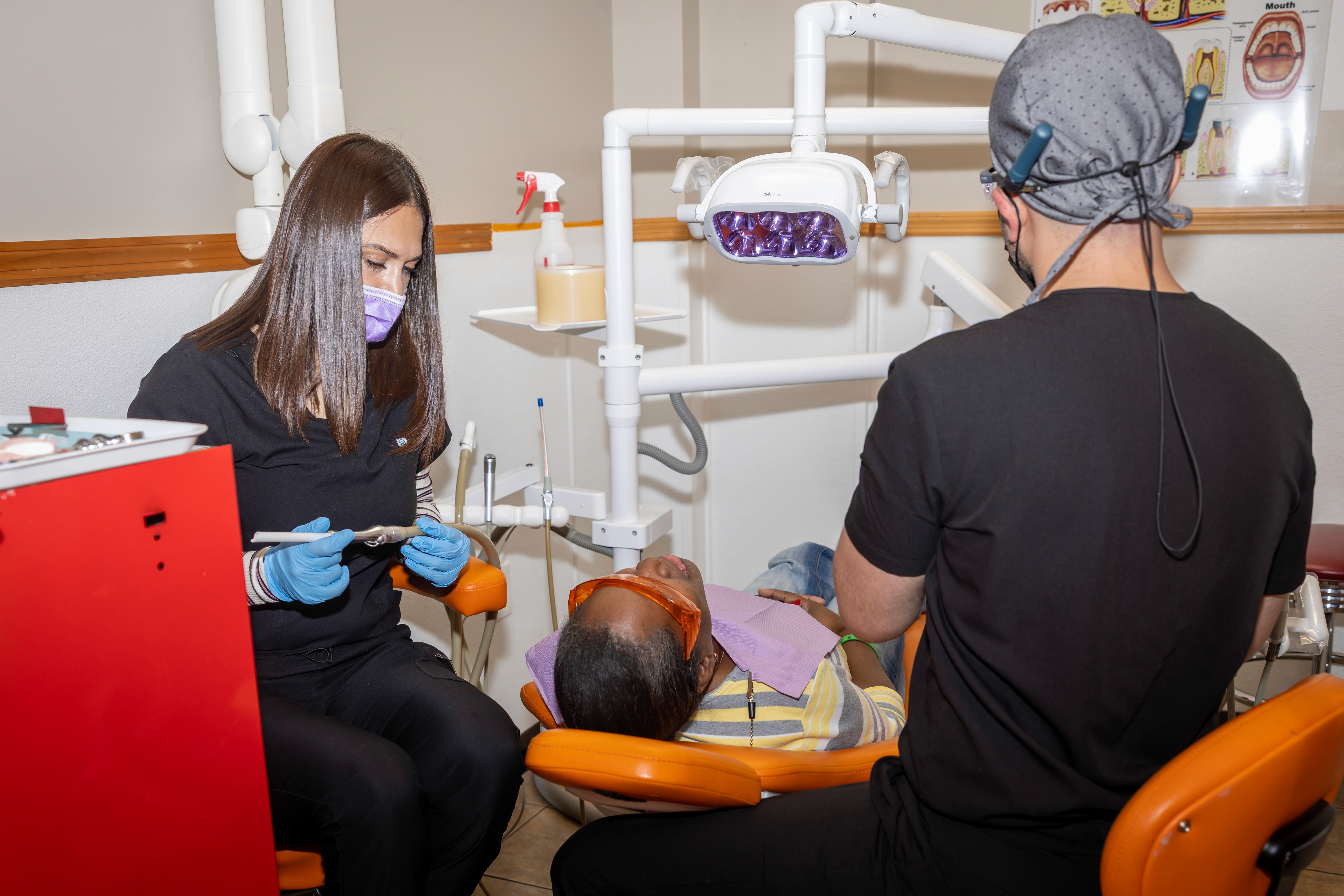
A sinus lift is a surgical procedure performed in the dental office, typically under local anesthesia and often with sedation for patient comfort. Dr. Yoel Santiago, who has placed implants for patients across West New York and Hudson County, begins by making a small incision in the gum tissue near the upper back teeth. A section of the bone is gently moved inward, lifting the sinus membrane upward. The space created beneath that membrane is then packed with bone graft material.
What type of bone graft is used?
We typically use a combination of materials depending on each patient's anatomy and health history. Options include processed human donor bone (allograft), bovine-derived mineral (xenograft), or a mix of both. Synthetic options are available as well. The graft material acts as a scaffold that your body's own bone cells gradually replace over several months. By the time you're ready for implant placement, the area contains your own living bone.
Lateral versus crestal approach
There are two main techniques. The lateral window approach, which is the most common, involves opening a small window in the side wall of the sinus and is used when significant bone height is needed. The crestal (or transcrestal) approach is performed through the implant socket itself and is used when only a few millimeters of additional height are required. Dr. Santiago selects the approach based on your CT scan measurements. In our West New York practice, we use cone beam CT imaging to plan every sinus lift case so there are no surprises during surgery.
According to the American Dental Association's MouthHealthy resource, dental implants are one of the biggest advances in dentistry over the past 40 years, and procedures like sinus lifts have expanded implant eligibility to patients who previously had no good options for permanent tooth replacement. That is meaningful for our Hudson County patients who were told by other offices that implants weren't possible for them.

Recovery, Healing, and What to Expect After Your Sinus Lift
The recovery from a sinus lift is manageable for most patients, though it does require patience. Swelling and mild discomfort are normal in the first week. We send every patient home with detailed post-op instructions, a prescription if needed, and a number to call us directly if anything feels off. Our team follows up within 48 hours by phone for all surgical patients.
Timeline from sinus lift to final implant
Weeks 1-2: Healing from the surgery itself. Soft foods, no blowing your nose, avoid strenuous activity.
Months 2-4: Bone graft integrating. Most patients feel completely back to normal during this phase.
Months 4-9: Follow-up CT scan confirms the new bone is dense enough to support an implant. When the scan looks good, Dr. Santiago schedules implant placement.
Months 9-12: Implant integrates with the new bone (osseointegration). Final crown is placed once integration is confirmed.
Who is a good candidate?
Most patients who need a sinus lift in the upper jaw are good candidates as long as their sinuses are healthy. Chronic sinusitis or prior sinus surgery can complicate the procedure, which is why we review your health history and imaging carefully before recommending it. Non-smokers heal faster and have better outcomes. If you smoke, Dr. Santiago will talk with you honestly about how that affects your timeline and what steps to take before surgery.
Many of our West New York patients arrive at their consultation having been told by other practices that they simply don't have enough bone for implants. We typically find that a sinus lift, sometimes combined with a bone grafting procedure, opens the door to full implant candidacy for the majority of those patients. It is one of the most rewarding parts of what we do at Veda. For a full overview of the implant process, see our complete 2026 dental implants guide.
We also offer sedation dentistry for patients who feel anxious about surgical procedures. You will not be alone in that chair, and you will not be uncomfortable. That is something our team takes seriously at every appointment.
Ready to Find Out If a Sinus Lift Is Right for You?
If you've been told you lack the bone needed for dental implants in West New York or Hudson County, Dr. Yoel Santiago would be glad to review your imaging and give you a straightforward answer. We accept most major insurance plans and offer CareCredit and in-house financing for procedures insurance doesn't cover.
Book your consultation on Zocdoc or call us at (201) 559-0807. Our office is at 5405 Bergenline Ave, Suite 1, West New York, NJ.