Mar 23, 2026
UNDERSTANDING YOUR OPTIONS AND THE DECISION AHEAD
Root Canal vs. Extraction: Making the Right Choice to Save Your Natural Tooth
Your tooth is severely painful. The pain wakes you up at night. It hurts when you chew. Over-the-counter pain medication barely touches it. You finally call your dentist, and they tell you that your tooth is severely infected and you have two options: a root canal or extraction.
Your heart sinks. You're facing an uncomfortable decision. You've heard scary stories about root canals. You've also heard that extracted teeth lead to bone loss and other problems. You're not sure which choice is the right one. You're worried about cost. You're worried about pain. You're worried about the long-term consequences of either decision.
Here's what we want you to know: while neither option is ideal, both are legitimate treatments that can help you. A root canal saves your natural tooth. An extraction removes the problem tooth but creates new challenges. At Veda Family Dentistry in West New York, Dr. Moosavi specializes in both endodontic (root canal) treatment and oral surgery (extraction). He can explain both options objectively, discuss the pros and cons of each, and help you make an informed decision about which is right for your specific situation.
In this comprehensive guide, we'll explain what a root canal is, what extraction involves, the costs of each, the long-term consequences of each choice, and what happens after each procedure. By the end, you'll understand both options clearly and be able to make a decision with confidence.
The Painful Tooth: What's Actually Wrong?
Before deciding between a root canal and extraction, it's helpful to understand what's causing the pain.
Why Teeth Hurt: Inside the Tooth
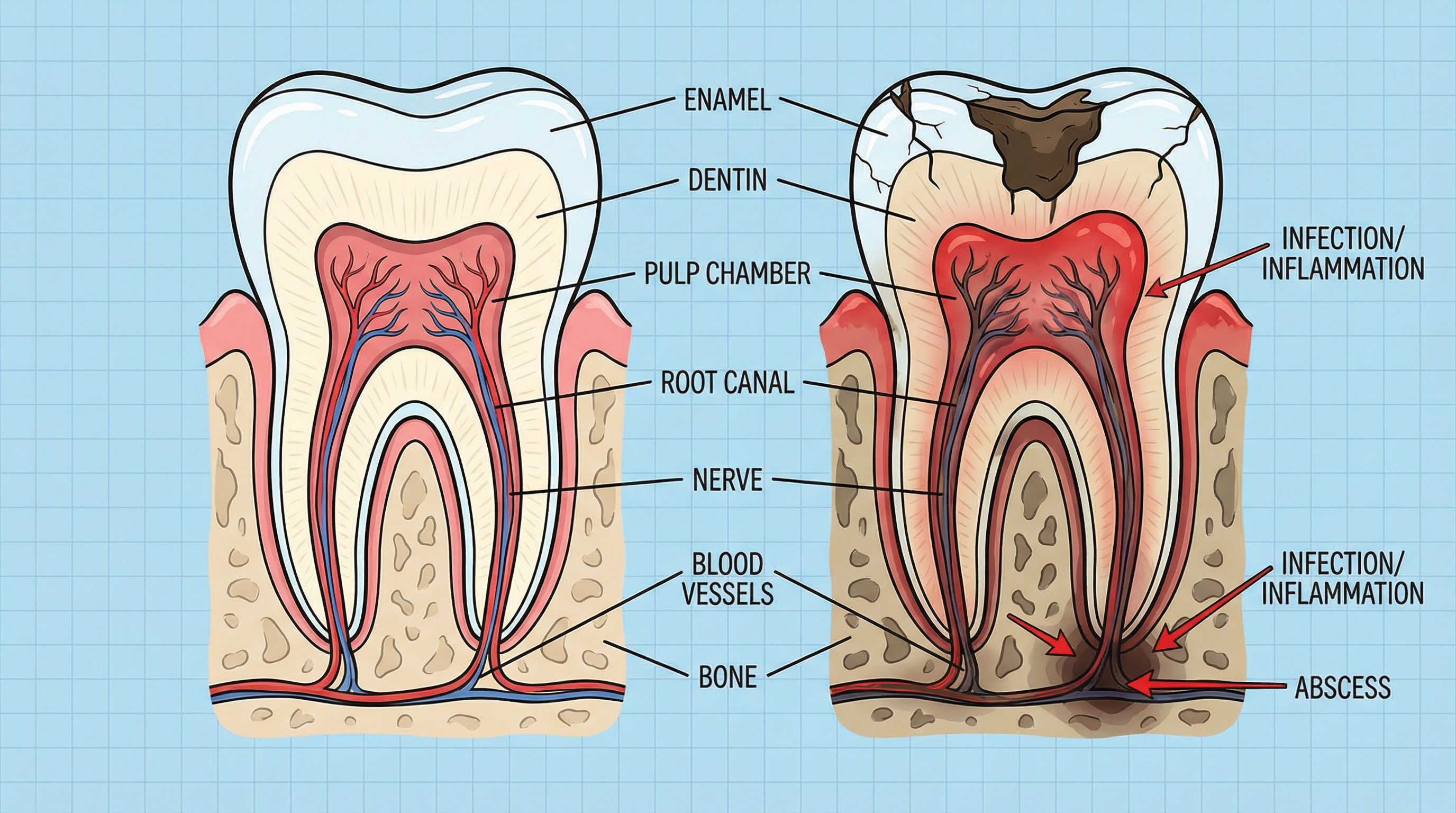
Inside every tooth is a space called the pulp chamber. The pulp contains nerves and blood vessels. When your tooth is healthy, the pulp is protected by layers of enamel and dentin. But when a cavity is large, when a tooth is cracked, or when a tooth is traumatized, bacteria can reach the pulp.
When bacteria infect the pulp, your immune system responds with inflammation. The inflammation creates pressure inside the tooth, pressing on the nerve. This pressure is what causes the severe, throbbing pain associated with an infected tooth. According to the American Association of Endodontists, an infected tooth pulp is one of the most painful conditions humans can experience.
The pain will not go away on its own. The infection will not resolve without treatment. The options are root canal treatment (to remove the infected pulp) or extraction (to remove the entire tooth).

ROOT CANAL TREATMENT EXPLAINED
What Is a Root Canal?
A root canal is endodontic treatment that removes the infected pulp from inside your tooth, cleans out the infection, disinfects the space, and seals the tooth. The goal is to eliminate the infection and save your natural tooth.
The Root Canal Procedure: Step by Step
Understanding what actually happens during a root canal can reduce anxiety about the procedure.
Anesthesia: Dr. Moosavi numbs the tooth and surrounding area with local anesthetic, similar to what you'd get for a filling. You won't feel pain during the procedure, though you might feel pressure or vibration.
Isolation: He places a rubber dam around the tooth to keep it dry and separate from your saliva during the procedure.
Access: He creates a small opening in the crown (top) of the tooth to access the pulp chamber inside.
Pulp Removal: He uses specialized instruments to carefully remove the infected pulp from the pulp chamber and the root canals (small tubes that run through the roots).
Cleaning and Shaping: He uses increasingly larger instruments and disinfecting solutions to clean and shape the inside of the canals.
Disinfection: He places disinfecting medication inside the tooth to eliminate any remaining bacteria.
Sealing: Once the tooth is cleaned and disinfected, he fills the canals with a biocompatible material called gutta percha and seals the access opening with a filling.
The entire procedure typically takes 60 to 90 minutes for a single-rooted tooth, though multi-rooted teeth (like molars with three or more roots) might take longer.
After the Root Canal
After the root canal, your tooth is no longer alive (the nerve is gone), but it's still functional. You can chew on it. It won't hurt. However, a tooth that's had a root canal is more brittle than a living tooth and is at higher risk of cracking. For this reason, Dr. Moosavi often recommends placing a crown on a tooth after a root canal to protect it and ensure long-term success.
Root Canal Cost
A root canal in New Jersey typically costs $800 to $1,500, depending on:
Which tooth is being treated (front teeth are simpler than back teeth)
How many roots the tooth has (front teeth have one root, molars have three)
The complexity of the case (some canals are harder to locate and clean)
Whether the endodontist is a specialist or a general dentist
If a crown is recommended afterward (which is often the case), add $1,200 to $2,500 for the crown.
Root Canal Success Rate
According to the American Association of Endodontists, root canal treatment has a success rate of 95% or higher when performed by trained professionals. A tooth that's had a successful root canal can function perfectly for 20+ years or even a lifetime.
Root Canal Advantages
The benefits of choosing root canal treatment include:
Tooth Preservation: You keep your natural tooth. Natural teeth are always preferable to replacements because they're stronger, function better, and don't require the maintenance that replacements do.
Long-Term Value: Over 20 years, root canal treatment is typically less expensive than extraction followed by implant replacement.
Function: A tooth with a root canal functions normally. You can eat, chew, and use it like any other tooth.
Maintenance: Minimal ongoing maintenance. You just brush, floss, and visit the dentist regularly like you do with all your teeth.
Longevity: A successfully treated root canal tooth can last 20+ years or even a lifetime.
Bone Preservation: Because you keep the tooth root, your jawbone is preserved. The root stimulates the bone, keeping it healthy.
Root Canal Disadvantages
The drawbacks are relatively minor:
Cost: Root canal treatment is expensive upfront.
Time: The procedure takes one to two hours, and you might need follow-up visits.
Pain Misconception: Many people fear root canals because they think they're painful. In reality, root canal treatment relieves pain (it removes the source of pain). The tooth is numb during the procedure. However, there might be some soreness after the procedure that resolves within a few days.
Tooth Sensitivity: Some patients experience temporary sensitivity after a root canal, though this usually resolves quickly.
Not Always Successful: Though success rates are high, sometimes a root canal doesn't work and the tooth needs to be extracted anyway. Retreatment is sometimes possible, but it's more expensive.

TOOTH EXTRACTION EXPLAINED
What Is Tooth Extraction?
Extraction is the removal of the entire tooth, roots and all. It's a more invasive procedure than a root canal, but it's faster and sometimes necessary if the tooth can't be saved.
The Extraction Procedure
Anesthesia: Dr. Moosavi numbs the tooth and surrounding area with local anesthetic.
Loosening: He uses specialized instruments to gently loosen the tooth by moving it back and forth, stretching the ligament that holds it to the bone.
Removal: Once the tooth is loose enough, he removes it carefully with forceps.
Socket Care: After the tooth is removed, he cleans the socket and might place bone graft material or a clot stimulant to promote healing.
Closure: He might place sutures if necessary to help the socket heal properly.
The entire procedure typically takes 20 to 30 minutes for a single tooth, though complex extractions might take longer.
After Extraction
After extraction, your body begins healing the socket. A blood clot forms, which is essential for healing. Avoid disturbing the clot by not smoking, not using a straw, and not rinsing vigorously for the first few days.
Most patients experience some swelling and discomfort for the first three to five days. Over-the-counter pain medication and ice therapy help manage this. Most people can return to normal activities within a week, though complete healing takes several weeks to months.
Extraction Cost
A simple tooth extraction in New Jersey typically costs $75 to $300, significantly less than a root canal.
However, the cost of extraction doesn't tell the whole story. After extraction, you'll need to replace the tooth, which adds substantial cost.
Extraction Advantages
The benefits of extraction include:
Quick and Simple: The procedure is faster than a root canal.
Lower Initial Cost: Extraction is much cheaper than root canal treatment upfront.
Definitive Solution: You're done. The problem tooth is gone.
No Further Treatment on That Tooth: You don't need to worry about follow-up appointments or retreatment.
Extraction Disadvantages
The disadvantages are significant and long-lasting:
Bone Loss: Once a tooth is extracted, the bone that supported it begins to resorb (get absorbed by the body). You lose the stimulus that the tooth root provided. Within the first year, you can lose up to 25% of the bone in that area. Bone loss continues over time, reshaping your jawbone and facial structure.
Tooth Shifting: Adjacent teeth shift into the space left by the extracted tooth, causing crowding and bite problems.
Opposite Tooth Drifting: The tooth in the opposite arch (top or bottom) that was in contact with the extracted tooth drifts upward or downward into the space. This can cause bite problems and make future tooth replacement difficult.
Facial Changes: Over years, significant bone loss can change your facial structure, making you look older.
Need for Replacement: A missing tooth creates functional and aesthetic problems. Most people want to replace an extracted tooth, which brings significant costs.
Replacement Options Are Expensive: Replacing a missing tooth costs more than the root canal would have cost.
The Cost Comparison: Root Canal vs. Extraction and Replacement
Let's compare the total cost of keeping the tooth with a root canal versus extracting and replacing it.
Scenario 1: Keep the Tooth with Root Canal
Root canal: $1,000
Crown: $1,500
Maintenance over 20 years: $2,000 (cleanings and regular care)
Total 20-year cost: approximately $4,500
Scenario 2: Extract and Replace with Implant
Extraction: $200
Waiting period for bone to heal: 3 to 6 months
Bone graft (if needed): $500 to $3,000
Implant placement: $1,500
Implant crown: $1,500
Maintenance over 20 years: $2,000
Total 20-year cost: approximately $5,700 to $8,700
Scenario 3: Extract and Replace with Bridge
Extraction: $200
Bridge (3 teeth): $3,000 to $5,000
Grinding of adjacent teeth: (included in bridge cost, but damages those teeth)
Replacement every 10 years: $3,000 to $5,000
Total 20-year cost: approximately $6,200 to $10,200
Scenario 4: Extract and Live with Missing Tooth
Extraction: $200
No replacement
However, facial changes and functional problems add quality of life cost
As you can see, keeping the tooth with a root canal is typically the most cost-effective option over the long term. Even though the upfront cost is higher, the total cost of ownership is usually lower than extraction and replacement.
MAKING YOUR DECISION AND MOVING FORWARD
When Root Canal Is the Best Choice
Dr. Moosavi recommends root canal treatment when:
The Tooth Is Salvageable: If the tooth structure is intact and strong enough to function, saving it is preferable.
You Want to Preserve Bone: If preserving your jawbone is important for future dental work or facial structure, keeping the tooth (and its root) is valuable.
You Want Long-Term Value: If you're thinking about the next 20 years, root canal treatment typically provides better long-term value than extraction and replacement.
You Want to Avoid Bone Loss and Shifting: If you want to avoid the cascade of problems that comes with extraction, keeping the tooth is preferable.
When Extraction Might Be Necessary
Dr. Moosavi recommends extraction when:
The Tooth Is Beyond Repair: If the decay or damage is so extensive that the tooth can't be restored, extraction is necessary.
Root Structure Is Severely Damaged: If the roots are fractured or severely compromised, the tooth might not be able to support a crown after root canal treatment.
Advanced Periodontitis: If gum disease has destroyed the bone supporting the tooth, extraction might be necessary.
Repeated Root Canal Failure: If you've had a root canal and it failed, retreatment might not be successful. Extraction and replacement might be the better option.
Financial Constraints: If you truly cannot afford root canal treatment and crown, extraction might be the immediate option (though consider financing options).
Patient Preference: Some patients strongly prefer extraction to root canal, even when root canal is technically possible. Dr. Moosavi respects patient preferences.
Common Myths About Root Canals and Extractions
Myth 1: Root canals are extremely painful
Truth: Root canal treatment is designed to eliminate pain. The tooth is numb during the procedure. You might feel pressure but not pain. Some soreness after the procedure is normal, but severe pain is not typical. If you experience severe pain after a root canal, contact Dr. Moosavi.
Myth 2: Extracted teeth are a simple solution
Truth: Extraction solves the immediate problem but creates long-term complications including bone loss, tooth shifting, and the need for costly replacement.
Myth 3: A dead tooth will eventually fall out
Truth: False. A tooth that has had a root canal stays in place indefinitely. The tooth is sealed. It won't suddenly fall out. It functions normally, though it's slightly more brittle than a living tooth.
Myth 4: Extracted teeth don't cause problems
Truth: Bone loss and tooth shifting are common long-term consequences of extraction.
Myth 5: Implants are always better than root canals
Truth: Implants are excellent replacements, but they're not always better than keeping the natural tooth. Natural teeth are stronger and require less maintenance than implants. When you have the choice to keep a natural tooth or replace it with an implant, keeping the natural tooth is usually preferable.
What Happens During Your Consultation
When you come to Veda Family Dentistry with a painful tooth, here's what happens:
Examination and Imaging: Dr. Moosavi examines your tooth and takes X-rays to determine the extent of the problem. He might take a 3D CBCT scan to get a complete picture.
Discussion of Findings: He explains exactly what he sees: is the tooth infected? Is there decay? Is there bone loss? Is the structure salvageable?
Explanation of Both Options: He explains root canal treatment and extraction objectively, discussing the pros and cons of each based on your specific situation.
Honest Recommendation: He recommends the option that he believes will give you the best long-term outcome, based on his clinical judgment and your specific situation.
Discussion of Your Preferences: If you have a strong preference for one option or the other, he listens and respects that. However, if your preferred option isn't possible (e.g., you want root canal but the tooth is beyond repair), he'll be honest about that.
Explanation of Costs: He explains the cost of whatever option you choose and discusses financing options if needed.
Decision: Together, you decide which option is right for you.
Schedule Your Tooth Preservation Assessment
If you have a painful tooth or have been told you need root canal or extraction, the first step is a comprehensive assessment with Dr. Moosavi.
Call Veda Family Dentistry to schedule your tooth preservation assessment. You can also book online at your convenience.
Dr. Moosavi will examine your tooth, explain your options, and help you make the best decision for your long-term oral health. Whatever you decide, you'll have expert care from someone who understands both root canal treatment and extraction and can guide you toward the best outcome for your specific situation.
Your natural tooth is worth saving if it can be saved. Let's explore whether your tooth is a candidate for root canal treatment or whether extraction is truly necessary.
“I’ve never felt so comfortable at a dental office. Everyone here truly cares and takes the time to explain everything clearly.”
Maria Alvarez
Teacher


