Mar 23, 2026
Invisalign vs. Traditional Braces in West New York: Cost Comparison & Which Is Right for You
You've finally decided it's time to straighten your teeth. You're tired of feeling self-conscious about your smile. You've researched your options, and now you're facing a big decision: should you go with Invisalign clear aligners or traditional braces? Both are effective, but they work differently, cost differently, and fit into your life differently. The right choice depends on your specific situation, your budget, your lifestyle, and your commitment level.
If you're a busy professional who needs discretion, Invisalign might be perfect. If you have severely crowded teeth and need the most powerful tooth-moving system available, traditional braces might be the better choice. If cost is your primary concern, braces are typically less expensive. If you can't bear the thought of metal wires and brackets in your mouth, Invisalign offers the discretion you're looking for.
At Veda Family Dentistry in West New York, Dr. Priya specializes in both Invisalign and traditional braces. She's helped hundreds of patients achieve straighter, healthier smiles using both systems. In this comprehensive guide, we'll break down Invisalign vs. braces in every way that matters: cost, treatment time, effectiveness, lifestyle impact, appearance, maintenance, and long-term results. By the end, you'll understand the pros and cons of each option and be able to make an informed decision about which is right for you.
Understanding Invisalign: Clear Aligners That Are Virtually Invisible
Invisalign clear aligners have revolutionized orthodontics by offering a discreet alternative to traditional braces. Instead of metal brackets and wires, Invisalign uses a series of custom-made, removable plastic trays that gradually shift your teeth into the desired position.
How Invisalign Works
Invisalign treatment begins with a consultation where Dr. Priya will assess your teeth and determine if you're a candidate for Invisalign. If you are, she'll take digital impressions of your teeth using advanced 3D scanning technology. Unlike traditional impressions that feel uncomfortable, digital scanning takes just minutes and is completely painless. According to the official Invisalign website, these digital impressions are used to create a customized treatment plan showing exactly how your teeth will move throughout the entire treatment process.
Once your treatment plan is created, a series of custom aligners (usually 20 to 60 trays, depending on the complexity of your case) is manufactured for you. You wear each aligner for one to two weeks before moving to the next one. Each aligner is slightly different, moving your teeth a small amount toward the final position. It's like a slow, gradual dance that happens over months or years.
Invisalign Treatment Timeline
For mild to moderate cases, Invisalign typically takes 6 to 12 months. More complex cases might take 18 to 24 months. This is often faster than traditional braces for simple cases, though comparable to braces for more complex movements. According to research from the American Association of Orthodontists, the timeline depends heavily on the complexity of the case and patient compliance with wearing the aligners.
Invisalign Cost in New Jersey
Invisalign typically costs $3,000 to $8,000 in New Jersey, depending on the complexity of your case and the length of treatment. This is typically higher than metal braces but comparable to ceramic braces. Most dental insurance plans cover 50% of orthodontic treatment (both Invisalign and braces) if the treatment is deemed medically necessary. This means your out-of-pocket cost might be $1,500 to $4,000 after insurance, depending on your plan.
Invisalign Financing
Dr. Priya understands that orthodontic treatment is an investment. She offers flexible payment plans and accepts CareCredit financing, allowing you to pay for your Invisalign treatment over time without interest (if you pay within the promotional period).
Invisalign Advantages
The benefits of Invisalign are significant for many patients:
Virtually invisible: The clear aligners are nearly impossible to see, making them perfect for professionals, public speakers, or anyone who's self-conscious about braces
Removable: You can take them out to eat, drink, and clean your teeth. No food restrictions like with braces
Easier to clean: You brush and floss normally, without having to work around brackets and wires
Comfortable: No sharp wires or brackets to irritate your mouth or lips
Fewer appointments: You don't need monthly adjustments like with braces. You can often do check-ups every 6 to 8 weeks
Faster for some cases: For mild to moderate cases, Invisalign can be faster than braces
Digital preview: You can see exactly how your teeth will look when treatment is complete before you even start
Invisalign Disadvantages
Invisalign isn't perfect for everyone. Here are the drawbacks:
Requires discipline: You must wear the aligners 20 to 22 hours per day for them to work. Many people take them out and forget to put them back in
Easy to lose: Because they're removable, it's easy to lose or forget them
Cost: Invisalign is typically more expensive than metal braces due to the custom manufacturing process
Not ideal for severe cases: Very complex orthodontic problems might require traditional braces for optimal results
Risk of damage: The aligners are plastic and can crack if you sit on them or step on them (which happens more often than you'd think)
Speech initially: Some people notice a slight lisp when they first start wearing the aligners, though this usually disappears within a few days
Understanding Traditional Braces: The Gold Standard of Orthodontics
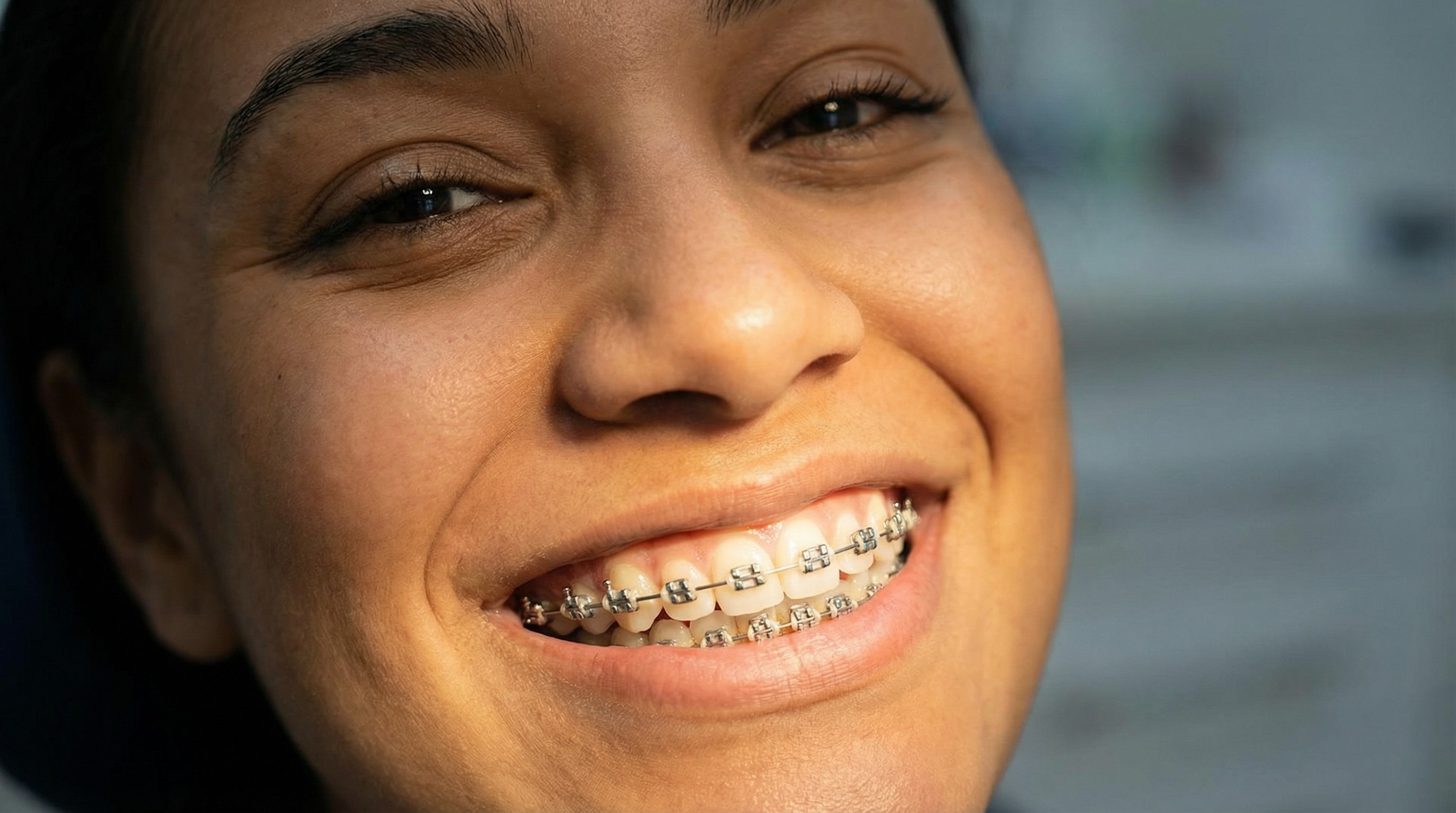
Traditional braces have been around for decades and remain the most versatile and powerful orthodontic tool available. They consist of metal (or ceramic) brackets bonded to each tooth, connected by archwires that apply constant, gentle pressure to move teeth.
How Traditional Braces Work
With traditional braces, Dr. Priya bonds small brackets to each tooth and threads archwires through them. The wires apply gentle, continuous pressure that gradually moves your teeth toward the desired position. Every 4 to 6 weeks, you come back for an adjustment where Dr. Priya tightens the wires to increase the pressure and continue tooth movement.
According to the American Association of Orthodontists, traditional braces are highly effective at moving teeth in multiple directions simultaneously, making them ideal for complex orthodontic problems.
Types of Braces Available
There are several types of traditional braces, each with different appearance and cost considerations:
Metal braces: The most common and most affordable option. Stainless steel brackets are visible but durable and effective. Cost: $2,500 to $6,000
Ceramic braces: Similar to metal braces but with tooth-colored or clear brackets that blend with your teeth. Less visible than metal but can stain if you're not careful. Cost: $4,000 to $8,000
Lingual braces: Brackets are placed on the inside (lingual) of your teeth, making them completely invisible. However, they're more expensive and can affect speech. Cost: $8,000 to $10,000+
Traditional Braces Timeline
Traditional braces typically take 18 to 36 months, depending on the complexity of the case. More complex cases naturally take longer. Once treatment is complete, you'll wear a retainer (usually fixed behind your upper teeth and/or a removable retainer you wear nightly) to maintain your results.
Traditional Braces Cost in New Jersey
Traditional metal braces cost $2,500 to $6,000 in New Jersey. Ceramic braces cost $4,000 to $8,000. Like Invisalign, most insurance plans cover about 50% of orthodontic treatment, so your actual out-of-pocket cost depends on your insurance and the type of braces you choose.
Braces Financing
Dr. Priya offers flexible payment plans for braces, allowing you to pay over the course of treatment. Many offices break the cost into monthly payments spread over the treatment period, making it more manageable.
Traditional Braces Advantages
The benefits of traditional braces include:
Most effective for complex cases: Braces can handle virtually any orthodontic problem, including severe crowding, bite problems, and complex rotations
No discipline required: Once they're bonded to your teeth, you can't take them out, so you don't have to remember to wear them
Faster for complex cases: For severe problems, braces are often more efficient than Invisalign
More affordable: Metal braces are typically less expensive than Invisalign
Proven track record: Braces have been used successfully for decades with predictable results
Color options: With traditional braces, you can choose bracket colors, allowing some personalization. Many teenagers enjoy this aspect
Traditional Braces Disadvantages
The drawbacks of traditional braces include:
Visible: Metal brackets and wires are noticeable, which bothers many adults
Food restrictions: You have to avoid sticky, hard, or crunchy foods that could break the brackets or wires
More difficult to clean: You need special tools and techniques to brush and floss effectively with braces. Food particles get trapped easily
Discomfort: Metal brackets can irritate your lips and cheeks, especially at the beginning of treatment
More appointments: You need monthly adjustments to tighten the wires
White spots: If you don't brush well, you can develop permanent white spots on your teeth where the brackets were bonded
Potential mouth sores: The wires and brackets can cause sores and ulcers on your inner cheeks and lips
Breaking Down the Costs: Invisalign vs. Braces
Let's get specific about costs, because this is often the deciding factor for many patients.
Invisalign Costs
Basic treatment: $3,000 to $5,000 (mild cases)
Moderate treatment: $5,000 to $7,000 (moderate cases)
Complex treatment: $7,000 to $8,000+ (complex cases)
What's Included in Invisalign Cost?
Your Invisalign treatment fee typically includes:
Digital impressions and treatment planning
All custom aligners for the entire treatment
Periodic check-ups and monitoring
Retainers after treatment is complete
Traditional Braces Costs
Metal braces: $2,500 to $6,000
Ceramic braces: $4,000 to $8,000
Lingual braces: $8,000 to $10,000+
What's Included in Braces Cost?
Your braces treatment fee typically includes:
Bonding and placement of brackets
Archwires and ligatures
Monthly adjustment appointments (usually 24 to 36 appointments)
Retainers after treatment is complete
Insurance Coverage Comparison
Most dental insurance plans provide orthodontic coverage if the treatment is medically necessary (rather than purely cosmetic). Typical coverage is:
Coverage level: 50% of treatment cost (some plans cover 60%)
Lifetime maximum: $1,200 to $2,000 (meaning insurance will pay that amount maximum over your lifetime)
Waiting periods: Some plans have a waiting period (often 6 to 12 months) before orthodontic coverage begins
For example, if your Invisalign treatment costs $6,000 and your insurance covers 50% with a $1,500 lifetime maximum, insurance would pay $1,500 and you'd pay $4,500.
Insurance Coverage for Both Systems
Good news: insurance typically covers both Invisalign and braces equally. They're both considered legitimate orthodontic treatment. So your insurance benefit won't differ between the two systems—your out-of-pocket cost difference is really just the cost difference between the two treatments themselves.
Real Cost Examples
Let's walk through realistic scenarios:
Scenario 1: Young Adult with Mild Crowding
Invisalign cost: $4,500
Insurance benefit: $1,500 (50% coverage, limited to $1,500 maximum)
Patient pays: $3,000
Alternative with metal braces:
Braces cost: $3,000
Insurance benefit: $1,500
Patient pays: $1,500
Scenario 2: Adult Professional with Moderate Case
Invisalign cost: $6,000
Insurance benefit: $1,500 (hits the lifetime maximum)
Patient pays: $4,500
Alternative with ceramic braces:
Ceramic braces cost: $6,000
Insurance benefit: $1,500
Patient pays: $4,500
In this case, the cost is the same, but Invisalign offers discretion.
Treatment Timeline Comparison
Invisalign Timeline
Mild cases: 6 to 9 months
Moderate cases: 12 to 18 months
Complex cases: 18 to 24 months
The biggest factor in Invisalign timeline is patient compliance. If you wear your aligners 20+ hours per day as directed, you'll progress on schedule. If you take them out frequently or forget to wear them, treatment will take much longer.
Traditional Braces Timeline
Mild cases: 12 to 18 months
Moderate cases: 18 to 24 months
Complex cases: 24 to 36 months
Braces tend to take longer because they move teeth in smaller increments than Invisalign. However, for some complex problems, braces can actually be faster because they can apply more force and handle more complex movements.
Timeline Factors That Apply to Both
Several factors affect how long treatment takes with either system:
Severity of the problem: More severe crowding, bite problems, or rotation take longer to fix
Your age: Younger patients' bones are more malleable, so teeth move faster
Bone density: Patients with denser bone move teeth more slowly
Compliance: For Invisalign especially, wearing your aligners consistently is critical
Patience: Some doctors prefer to move teeth more slowly for healthier, longer-lasting results

How Effective Are Invisalign and Braces Really?
Both Invisalign and traditional braces are highly effective at straightening teeth when used properly. According to the American Dental Association, both systems have similar success rates when patients follow their orthodontist's instructions.
Invisalign Effectiveness
Studies show that Invisalign achieves excellent results in 80 to 90% of cases when patients wear their aligners as directed (20+ hours per day). For mild to moderate cases, Invisalign results are virtually identical to traditional braces. However, for severe cases (significant bite problems, severe crowding, or complex rotations), traditional braces may be more effective.
Braces Effectiveness
Traditional braces are highly effective for all types of cases, from simple to extremely complex. According to research from the Journal of Clinical Orthodontics, braces provide highly predictable results and can handle virtually any orthodontic problem.
Success Depends on Your Case
The key is matching the right system to your specific case. Dr. Priya will evaluate you and recommend which system is best suited to your particular needs. For example:
If you have mild crowding, either system works equally well
If you have a severe bite problem, traditional braces might be more efficient
If you have complex rotations, braces might be more reliable
If you need discretion and have a simple case, Invisalign is ideal
Lifestyle Factors: Which Fits Your Life Better?
Beyond effectiveness, the right choice depends on how the treatment fits into your life.
Eating and Drinking with Invisalign
One of Invisalign's biggest advantages is that you can remove the aligners to eat and drink. This means:
No food restrictions: You can eat anything you want—sticky foods, hard candies, crunchy foods, all of it
Easier eating: You don't have to worry about food getting stuck in brackets or wires
Easy cleanup: After eating, you simply clean your aligners before putting them back in
Drink what you want: You can drink hot coffee, red wine, or sugary drinks while eating (though it's not recommended to drink anything but water while wearing the aligners)
Eating and Drinking with Braces
With traditional braces, you need to be more careful:
Food restrictions: You must avoid sticky foods (caramel, taffy, gum), hard foods (nuts, hard candy, ice), and very crunchy foods (chips, popcorn) that could break brackets
More difficult eating: You need to cut food into smaller pieces to avoid hitting brackets and wires
Cleaning: After eating, you need to brush and floss carefully to remove food particles trapped in brackets
Drinking: While you can drink anything, sugary drinks and acidic drinks can stain your teeth and cause decay around the brackets if you're not careful
Hygiene with Invisalign
Keeping your teeth clean is significantly easier with Invisalign:
Normal brushing and flossing: You brush and floss normally, without special tools or techniques
Clean aligners: You rinse your aligners daily and can soak them in special cleaning solutions
Less plaque buildup: Because you can remove the aligners, plaque buildup is typically less than with braces
According to research from the International Journal of Dentistry, patients with Invisalign generally have better oral hygiene than patients with braces because cleaning is easier.
Hygiene with Braces
Keeping your teeth clean with braces requires more effort:
Special brushing technique: You need to brush around brackets and under wires carefully
Special tools: Many patients use water flossers or floss threaders to clean between teeth
More time: Thorough cleaning takes longer with braces
Risk of white spots: If you don't brush well, permanent white spots can develop on your teeth
Harder to detect decay: Cavities can form under brackets without you realizing it
Appearance and Confidence
This is often the deciding factor for adults:
Invisalign: The aligners are nearly invisible, especially from a distance. If you're self-conscious about your appearance, Invisalign allows you to straighten your teeth without anyone really noticing
Braces: Metal brackets are obvious. Some professionals worry about how braces will affect their image. Ceramic braces are less visible but still noticeable. However, many teens actually enjoy the visibility and don't mind the appearance at all
According to the American Association of Orthodontists, adult orthodontic cases have increased significantly in recent years, driven largely by the availability of discreet options like Invisalign.
Speech
Some people notice temporary changes in speech with both systems:
Invisalign: Some people develop a slight lisp initially because the aligners take up space in their mouth. This usually disappears within a few days as your mouth adjusts
Braces: Braces don't typically affect speech, though lingual braces (on the inside of teeth) can affect speech more than traditional braces
Real Patient Stories: What Patients Say About Their Experience
Marcus's Story: The Professional Who Chose Invisalign
Marcus is a sales executive who meets with clients daily. When his teeth started shifting slightly in his 40s, he considered braces but worried about how they'd affect his professional image. He chose Invisalign and was thrilled with his choice.
"Nobody even knew I was doing it," Marcus says. "I wore the aligners except during client meetings, and nobody suspected a thing. The whole process took about a year, and now I have a straighter smile than I did in my 20s. For a professional, Invisalign was perfect."
Jennifer's Story: The Teen Who Embraced Braces
Jennifer's parents were worried about how braces would affect her confidence as a teenager. But Jennifer embraced it.
"I actually loved having braces," Jennifer says. "I got to choose pink brackets, and my friends thought it was cool. Plus, the braces worked faster than Invisalign for my case because I had a pretty severe bite problem. Now that they're off, I have a perfect smile, and the whole experience was positive."
David's Story: The Patient Who Tried Invisalign First
David started with Invisalign for moderate crowding but struggled with compliance. He frequently forgot to put the aligners back in after eating.
"I'm just not disciplined enough for Invisalign," David admits. "I switched to braces at the midpoint, and it was much better for me. The braces did the work for me—I didn't have to remember to wear them. Treatment took longer overall because I switched systems, but I'm happy with the result."
Choosing Between Invisalign and Braces: A Decision Framework
Here's a simple framework to help you decide which system is right for you:
Choose Invisalign If:
You're an adult who values discretion
You have mild to moderate orthodontic issues
You're highly disciplined and will wear the aligners 20+ hours per day
You want faster treatment (for simple cases)
You want to avoid food restrictions
You want easier cleaning and better hygiene
Choose Braces If:
You have a severe orthodontic problem (significant bite problem, severe crowding, complex rotations)
You're a teenager or young adult who doesn't mind the appearance
You want the most affordable option
You're not highly disciplined (since you can't remove braces)
You want the fastest results for complex cases
You prefer not to worry about remembering to wear a device
When Dr. Priya Might Recommend One Over the Other
During your consultation, Dr. Priya will examine your teeth and bite and recommend the system that's most appropriate for your case. For example:
If you have mild crowding and value discretion, she'll likely recommend Invisalign
If you have a severe bite problem, she might recommend braces as the more efficient choice
If you're young and have a complex case, she might recommend braces
If you're an adult with a simple case, she'll likely recommend Invisalign
Dr. Priya's primary goal is to achieve the best result for your teeth and gums. She'll recommend the system most likely to give you that result.
Cost-Benefit Analysis: Which Offers Better Value?
Beyond just price, consider the total value of each option:
Invisalign Value Proposition
Higher cost: $3,000 to $8,000
Faster for simple cases: 6 to 12 months vs. 12 to 18 months
Better lifestyle: No food restrictions, easier cleaning
Discretion: Almost invisible
Value for professionals: The discretion and lifestyle factors might be worth the higher cost
Braces Value Proposition
Lower cost: $2,500 to $6,000 for metal braces
Best for complex cases: More effective for severe problems
Proven results: Decades of successful use
No compliance needed: You can't forget to wear them
Value for teenagers: Affordable and effective
Schedule Your Free Invisalign Consultation with Dr. Priya
Ready to straighten your teeth? The first step is a consultation with Dr. Priya. During this visit, she'll:
Examine your teeth and bite thoroughly
Take digital impressions to assess your case
Explain which system is best for your specific situation
Discuss costs, financing options, and treatment timeline
Answer all your questions
Call Veda Family Dentistry to schedule your free consultation. You can also book online at your convenience.
Dr. Priya specializes in both Invisalign and traditional braces, so whether you ultimately choose one system or the other, you're getting expert care. What matters most is that you're taking the step to improve your smile and your confidence. Let's get you started on that journey today.
“I’ve never felt so comfortable at a dental office. Everyone here truly cares and takes the time to explain everything clearly.”
Maria Alvarez
Teacher


