Mar 23, 2026
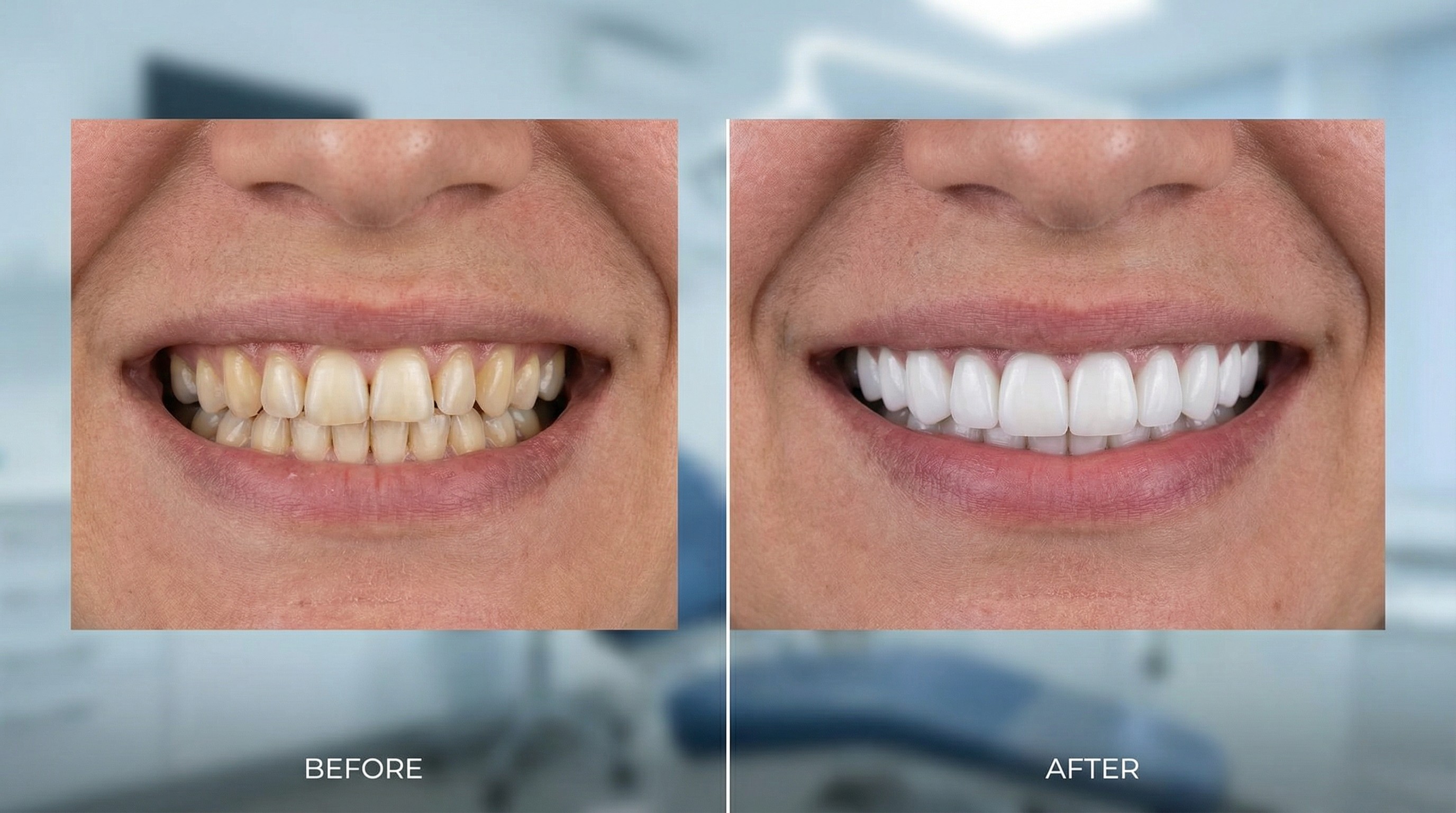
Dental Veneers Cost in NJ: Porcelain vs. Composite & Long-Term Durability Comparison
You've always wanted a brighter, whiter smile. You've always wished your teeth were a different shape or size. You've always wanted to close a gap or hide a chip. You've considered whitening, but that only addresses color. You've considered bonding, but you're not sure it's permanent enough. You've considered braces, but that takes years.
Then you discover dental veneers. You start researching and immediately get confused. There are two types: porcelain and composite. The costs are different. The durability is different. The longevity is different. You're not sure which one is right for you or whether the extra cost for porcelain is actually worth it.
At Veda Family Dentistry in West New York, Dr. Priya specializes in veneers. She's placed hundreds of veneers and has a nuanced understanding of when each type is the right choice. In this comprehensive guide, we'll explain exactly what veneers are, break down the costs of porcelain versus composite, discuss durability and longevity, explain who's a good candidate, and help you understand which option provides better long-term value for your situation.
By the end, you'll know the true cost of ownership for each option and be able to make an informed decision about which type of veneer is right for you.
What Are Dental Veneers?
Veneers are thin shells of material bonded to the front of your teeth. They're custom-made to match your teeth perfectly in shape, size, and color. Veneers cover the visible front surface of your tooth, completely transforming its appearance.
What Veneers Can Fix
Veneers are incredibly versatile. They can address:
Color Issues: Teeth that are permanently stained or discolored can be covered with bright white veneers. According to the American Academy of Cosmetic Dentistry, veneers are one of the most effective solutions for permanent tooth discoloration.
Shape and Size Problems: Teeth that are too small, too large, too pointed, or oddly shaped can be reshaped with veneers.
Gaps and Spacing: Gaps between teeth can be closed by making veneers slightly wider than your natural tooth.
Mild Crowding: Slightly overlapped or rotated teeth can sometimes be masked with veneers (though severe crowding usually requires orthodontics first).
Chipped or Worn Teeth: Teeth that are broken or worn smooth can be restored with veneers.
Length Issues: Teeth that are too short or too long can be resized with veneers.
Alignment Issues: Slightly tilted or protruding teeth can appear more aligned with veneers.
The key to understanding veneers is this: they change how your tooth looks from the front, but they don't change the underlying structure of the tooth. This is why they're cosmetic rather than restorative.

Porcelain Veneers: Premium Quality and Durability
Porcelain veneers are custom-made ceramic shells created in a dental laboratory. They're the gold standard of veneer treatment, and for good reason.
How Porcelain Veneers Are Made
The process begins with Dr. Priya preparing your tooth by removing a thin layer of enamel (typically about 0.5mm, roughly the thickness of a contact lens). She takes an impression of your prepared tooth, which is sent to a laboratory. At the laboratory, a ceramicist hand-crafts your veneer to match your specifications perfectly: the exact shade you want, the exact shape you designed, the exact contours that will look natural on your face.
You typically wear a temporary veneer while your permanent one is being made. Then you return for your final appointment where Dr. Priya bonds your permanent porcelain veneer to your tooth with a special adhesive. The entire process takes about two weeks.
Porcelain Veneer Costs
Porcelain veneers in New Jersey cost $800 to $2,500 per tooth. The cost varies based on:
Geographic location: Downtown areas cost more than suburban areas
Dentist experience: Highly experienced cosmetic dentists charge more
Laboratory quality: High-end laboratories charge more
Complexity: Veneers requiring significant tooth preparation cost more
At Veda Family Dentistry, porcelain veneers cost $900 to $1,800 per tooth, depending on complexity.
For a full smile makeover with veneers on six to ten teeth, you're looking at $5,400 to $18,000.
Insurance Coverage for Porcelain Veneers
Dental insurance typically does not cover porcelain veneers because they're considered cosmetic. However, if a veneer is replacing an old crown or repairing damage from decay, some insurance might cover a portion. Check with your specific insurance plan.
Porcelain Veneer Lifespan
Porcelain veneers typically last 10 to 15 years, though many last 20+ years with excellent care. The veneer itself doesn't wear out, but the adhesive can eventually fail, or your tooth underneath can develop decay around the edges.
Porcelain Veneer Advantages
The benefits of porcelain veneers are significant:
Appearance: Porcelain has optical properties similar to natural tooth enamel. Light passes through it and reflects off the underlying tooth, creating a natural, beautiful appearance that's virtually indistinguishable from natural teeth. This is why porcelain is preferred for the most visible teeth.
Stain Resistance: Porcelain doesn't stain. Even if you drink coffee, red wine, or smoke, your porcelain veneer won't discolor. The underlying tooth is sealed and protected, so it won't discolor either.
Durability: Porcelain is extremely hard and resists scratching and chipping. You can eat normally without worrying about damaging your veneers.
Longevity: With proper care, porcelain veneers last 10 to 20 years, which is excellent value when divided by years of use.
Professional Look: For patients who want the absolute best aesthetic result, porcelain delivers. The quality and longevity justify the investment.
Porcelain Veneer Disadvantages
The drawbacks are minimal:
Cost: Porcelain veneers are more expensive than composite veneers upfront.
Irreversible: Tooth preparation is permanent. Once enamel is removed, it doesn't grow back.
Not Repairable: If your porcelain veneer chips, it typically needs to be replaced entirely (not repaired).
Timeline: Takes two to three weeks to complete (you can't do it in one appointment).
Risk of Sensitivity: Some patients experience tooth sensitivity after preparation, though this usually resolves within days or weeks.
Composite Veneers: Budget-Friendly and Reversible
Composite veneers are made of tooth-colored resin bonded directly to your tooth. They can be completed in one appointment, making them a convenient and affordable option.
How Composite Veneers Are Made
During a single appointment, Dr. Priya applies composite resin directly to your tooth, carefully shaping and polishing it to create the desired appearance. She builds up the resin in layers, sculpting it to match your design perfectly. The entire process takes one to two hours for multiple teeth.
Because composite is applied directly by the dentist rather than made in a laboratory, it's faster and less expensive.
Composite Veneer Costs
Composite veneers in New Jersey cost $250 to $1,500 per tooth, significantly less than porcelain. At Veda Family Dentistry, composite veneers typically cost $400 to $900 per tooth.
For a full smile makeover with composite veneers on six to ten teeth, you're looking at $2,400 to $9,000.
Insurance Coverage for Composite Veneers
Like porcelain veneers, composite veneers are usually not covered by insurance because they're cosmetic. If composite is used to repair decay or damage, some insurance might cover a portion.
Composite Veneer Lifespan
Composite veneers typically last 5 to 7 years, significantly shorter than porcelain. The composite material can stain, chip, and wear over time.
Composite Veneer Advantages
The benefits of composite veneers include:
Affordability: Composite veneers cost 50 to 70% less than porcelain, making smile transformations more accessible financially.
Reversibility: Minimal tooth preparation means composite veneers are more reversible than porcelain. If you change your mind, your tooth hasn't been permanently altered as much.
Speed: Composite veneers can be completed in one appointment. No temporary veneers, no two-week wait.
Easy Repair: If a composite veneer chips, it can usually be repaired quickly by adding more composite, rather than replacing the entire veneer.
Good Enough for Many Cases: For patients on a budget or with lower aesthetic demands, composite veneers deliver satisfactory results.
Composite Veneer Disadvantages
The drawbacks are significant:
Appearance: Composite doesn't have the optical depth of porcelain. It can look slightly plastic or flat compared to natural teeth. From a distance it looks fine, but up close, it might not look quite as natural as porcelain.
Staining: Composite veneers stain easily. Coffee, tea, red wine, and smoking all cause staining. Even your underlying tooth can stain around the edges because the composite preparation is less sealed than porcelain.
Durability: Composite is softer than porcelain and chips and wears more easily. You need to be careful about what you bite on.
Short Lifespan: At 5 to 7 years, you're replacing composite veneers more frequently, which adds to long-term cost.
More Maintenance: Composite veneers require more frequent polishing and maintenance to keep them looking their best.
Porcelain vs. Composite: Cost Comparison Over Time
Let's do a real cost analysis comparing the two options over 20 years:
Porcelain Veneers Over 20 Years
Initial cost: $6,000 (for 6 teeth at $1,000 each)
Replacement cost: 1 replacement set in 20 years at $6,000
Maintenance: Professional polishing 2x per year at $100 per visit = $4,000
Total 20-year cost: approximately $16,000
Cost per year: $800
Composite Veneers Over 20 Years
Initial cost: $3,000 (for 6 teeth at $500 each)
Replacement cost: 3 replacement sets in 20 years (every 5-7 years) at $3,000 each = $9,000
Maintenance: Professional polishing every 3 months at $75 per visit = $6,000
Total 20-year cost: approximately $18,000
Cost per year: $900
When you break down the 20-year cost, porcelain and composite are surprisingly similar. But porcelain offers superior appearance and durability, which many patients feel justifies the higher upfront cost.

Am I a Good Candidate for Veneers?
Not everyone is a candidate for veneers, and Dr. Priya is selective about recommending them.
Good Candidates for Veneers
You're likely a good candidate if you:
Have healthy teeth and gums (no active decay or gum disease)
Have enough natural tooth structure (veneers require tooth preparation)
Have realistic expectations about appearance and maintenance
Are willing to commit to excellent oral hygiene
Don't have severe bite problems or grinding habits
Have minimal to moderate spacing or alignment issues
Not Good Candidates for Veneers
You might not be a good candidate if you:
Have severe crowding (orthodontics should come first)
Have significant bite problems (a bite correction might be needed first)
Have active gum disease (must be treated first)
Grind your teeth severely (veneers might chip)
Have very thin or weak tooth structure
Have unrealistic expectations
During your consultation, Dr. Priya will assess whether veneers are right for you.
Treatment Planning: Porcelain vs. Composite Decision
During your veneer consultation, Dr. Priya helps you decide whether porcelain or composite is right for your situation.
When Dr. Priya Recommends Porcelain
Dr. Priya typically recommends porcelain veneers for:
Front teeth that are highly visible: Porcelain's superior appearance is worth the investment
Permanent solutions: If you want to avoid replacement every 5 years
Patients with high aesthetic standards: Porcelain delivers premium results
Patients who drink coffee/wine/smoke: Porcelain's stain resistance is important
Patients seeking long-term value: Over 20 years, porcelain often costs less
When Dr. Priya Recommends Composite
Dr. Priya typically recommends composite veneers for:
Budget constraints: If cost is the primary concern
Test cases: To see how you like the look before committing to porcelain
Less visible teeth: Slightly less than perfect appearance is acceptable
Temporary solutions: If you're not sure you want permanent changes
Multiple areas: If you're covering many teeth, composite saves significantly
Quick treatment: If you need immediate results
Combination Approach
Many patients use a combination approach: porcelain veneers on the six most visible front teeth (where appearance matters most), and composite veneers on less visible teeth. This combines the best of both worlds: premium appearance where it matters most, and cost savings on teeth that are less visible.
Digital Smile Design for Veneers
Before any veneer treatment, Dr. Priya uses digital smile design to show you exactly what your teeth will look like with veneers.
How Digital Design Works
She takes a photo of your smile and uses specialized software to show different veneer designs. You can see your smile with different shapes, sizes, and colors. You can request adjustments: "Make them slightly more rounded" or "I want them a bit whiter." Dr. Priya adjusts until you're absolutely happy with the design.
Once you've approved the design, your permanent veneers are made to match that design perfectly. According to research from the Journal of Cosmetic Dentistry, digital smile design significantly improves patient satisfaction because patients know exactly what to expect.
Caring for Your Veneers: Long-Term Maintenance
Once you've invested in veneers, proper care ensures they last as long as possible.
Daily Care
Brush Gently: Use a soft-bristled toothbrush and brush gently, especially along the gumline where the veneer meets your natural tooth. Hard brushing can damage the edge of the veneer.
Avoid Hard Foods: Don't bite into hard candies, ice, or nuts. These can crack veneers. Cut apples and other hard foods into pieces instead of biting into them.
Careful with Teeth: Don't use your teeth to open packages or bite off tags. This is true of all teeth, but especially important with veneers.
Watch Staining Habits: While porcelain doesn't stain, composite does. With composite veneers, limit coffee, tea, red wine, and smoking. If you do consume staining substances, rinse your mouth with water afterward.
Professional Care
Regular Cleanings: Come in every six months for professional cleanings. The hygienist will clean your veneers gently without damaging them.
Professional Polishing: Composite veneers benefit from professional polishing every three to six months to keep them looking bright.
Check-ups: Dr. Priya will monitor your veneers during regular appointments, checking for any problems early.
Nightguard for Grinders
If you grind your teeth, wearing a nightguard protects your veneers from damage. This is especially important for composite veneers, which are more susceptible to chipping.
Veneer Myths Debunked
There are several misconceptions about veneers that we should address:
Myth 1: Veneers Look Fake
Truth: Quality porcelain veneers look completely natural. They're designed to mimic the appearance of natural teeth. Only poorly designed or overly white veneers look fake.
Myth 2: You Can't Whiten Your Teeth After Veneers
Truth: You can't whiten the veneers themselves because they're already tooth-colored. However, if you have natural teeth showing (like on your lower teeth), you can still whiten those. Just make sure your veneered teeth match your newly whitened natural teeth in shade.
Myth 3: Veneers Will Damage Your Natural Teeth
Truth: When placed correctly, veneers don't damage your natural teeth. The veneer protects the front surface of your tooth. The only concern is the tooth preparation, which removes a small amount of enamel. This is a calculated decision made with full knowledge of the implications.
Myth 4: Veneers Need to Be Replaced Every Few Years
Truth: Porcelain veneers last 10 to 20 years. Even composite veneers last 5 to 7 years. This is longer than most people think.
Myth 5: Veneers Are Too Expensive
Truth: While veneers are an investment, they're often less expensive than the multiple treatments you'd need to achieve the same result. For example, getting your teeth whitened, bonded, and shaped piecemeal might cost as much as or more than veneers.
Making Your Veneer Decision
By now, you should have enough information to decide whether veneers are right for you and which type is best.
Decision Framework
Choose Porcelain If:
You want the absolute best appearance
You're willing to invest upfront for long-term value
You drink coffee, tea, or wine regularly
You want to avoid frequent replacements
You want veneers on your most visible teeth
Choose Composite If:
Cost is your primary concern
You want to try veneers before committing permanently
You need treatment quickly (one appointment)
You're less concerned about slight staining
You want flexibility (easier to adjust or remove)
Choose a Combination If:
You want porcelain on visible front teeth and composite on less visible teeth
You want to balance appearance and cost
You want premium appearance where it matters most
Schedule Your Veneer Consultation with Dr. Priya
If you're interested in veneers, the next step is a consultation with Dr. Priya. During this appointment, she'll:
Examine your teeth and assess your candidacy
Discuss your aesthetic goals and concerns
Show you digital smile design mockups of potential veneers
Explain porcelain versus composite options for your situation
Discuss costs and financing options
Answer all your questions
Call Veda Family Dentistry to schedule your veneer consultation. You can also book online at your convenience.
Dr. Priya's goal is to help you achieve the beautiful smile you deserve while providing honest guidance about which veneer option offers the best value for your specific situation and needs.
Your smile transformation is just a consultation away. Let's get started.
“I’ve never felt so comfortable at a dental office. Everyone here truly cares and takes the time to explain everything clearly.”
Maria Alvarez
Teacher


