Quick Answer
TL;DR, you can be fully asleep, fully awake, or anywhere in between
You are not automatically put to sleep for dental implants, but you can be if you want. Most single-implant procedures are done under local anesthesia only, meaning you are fully awake but feel nothing. For longer cases, anxious patients, or full-arch surgeries, dentists offer four sedation tiers: local-only, nitrous oxide, oral conscious sedation, and IV sedation or general anesthesia. The right tier depends on the length of the procedure, your anxiety level, and your medical history. Here is what each one feels like, who it suits, and how our team in West New York matches sedation to the patient.
What are the four sedation tiers for implant surgery?
From fully awake to fully asleep, plus everything between
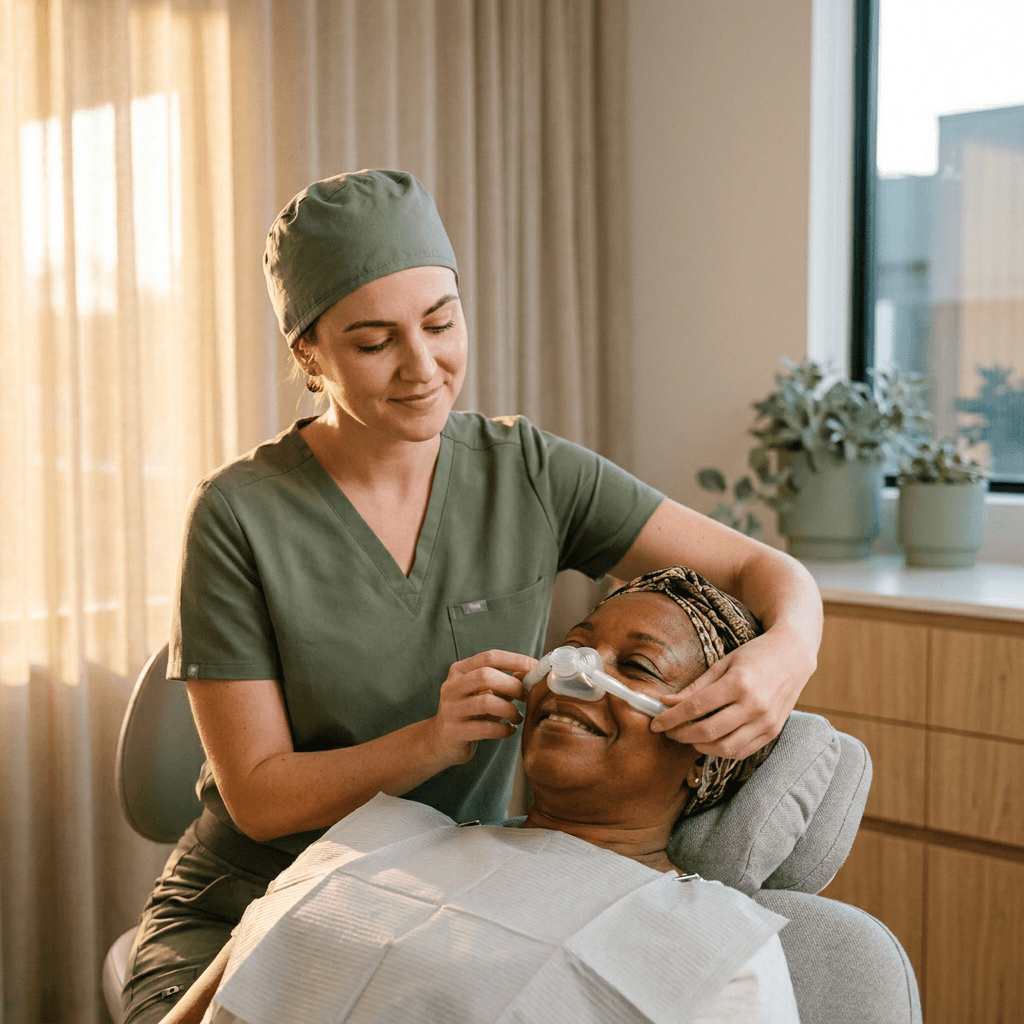
There are four well-established sedation options available for dental implant procedures, and understanding them in plain language removes most of the fear patients carry into the consultation. The first tier is local anesthesia only, meaning a numbing injection at the surgical site, the same anesthetic used for a routine filling. You are fully awake, fully aware, but you feel no pain, only pressure. The American Dental Association considers local-only the standard of care for most single implant placements when the patient is calm and the case is straightforward. The second tier is nitrous oxide, often called laughing gas, delivered through a small nose mask. Nitrous takes effect within minutes, produces a light floating feeling and softened anxiety, and wears off within five minutes after the mask comes off. You can drive yourself home afterward. The third tier is oral conscious sedation, a pill, usually triazolam or a similar benzodiazepine, taken about an hour before your appointment. You remain technically awake and able to respond, but you feel deeply relaxed and you typically remember very little of the procedure afterward. You absolutely cannot drive on oral sedation day and you need a ride home. The fourth tier is IV sedation, sometimes called twilight sedation, or full general anesthesia. With IV sedation you are not fully unconscious but you are deeply asleep, breathing on your own, monitored continuously, and you have no memory of the procedure. General anesthesia takes that one step further into full unconsciousness with an airway tube, and it is usually reserved for the most complex full-arch cases or for patients with severe medical or behavioral needs. Each tier has its place, and stronger is not automatically better.
Which sedation level is right for which patient?
Matching the tier to the procedure and the person
The right sedation choice depends on three honest variables: how long the procedure will take, how anxious you feel about dental work, and your medical history. For a single implant placement that takes 45 to 60 minutes in a healthy adult who is not particularly anxious, local anesthesia alone is usually plenty. Dr. Gladys Mota or Dr. Devipriya will often start that conversation by asking patients to rate their dental anxiety on a one-to-ten scale. Anything five or below typically does well with local-only or local plus nitrous. Six or higher, and we have a real talk about oral or IV options. For multi-implant cases, sinus lifts, bone grafts, or any full-arch same-day procedure, IV sedation tends to be the most humane choice. Not because the surgery hurts more, the local anesthetic still does the pain-blocking, but because sitting still through three to six hours of work is hard on the body and the mind. The medical history piece matters a great deal. Patients on certain antidepressants, blood thinners, or with sleep apnea need a tailored plan and sometimes a medical clearance from their physician before oral or IV sedation. Pregnancy generally rules out nitrous in the first trimester and most oral sedatives throughout, leaving local anesthesia as the safe path. Older patients on multiple medications need extra screening because drug interactions can magnify sedative effects unpredictably. We never push a patient into deeper sedation than they need, and we never refuse deeper sedation to a patient who is genuinely terrified of being awake. Both moves are wrong.

Is dental sedation safe, and what does each tier actually cost?
Safety record, monitoring, and real price differences
Dental sedation has an excellent safety record when administered by trained providers with proper monitoring, but the safety of any sedation tier depends entirely on the protocols of the practice using it. The American Dental Association requires specific permits for each level of sedation a dentist offers, and providers delivering moderate or deep sedation must complete dedicated training programs and maintain emergency airway certifications. At our West New York office we monitor every sedated patient with pulse oximetry, blood pressure, and end-tidal CO2 capnography, the same monitoring used in hospital outpatient surgery. Cost differences between tiers are real and worth knowing. Local anesthesia is included in the implant fee at virtually every practice and adds nothing extra. Nitrous oxide typically adds $75 to $125 per appointment. Oral conscious sedation usually adds $200 to $400 per visit. IV sedation runs $400 to $900 per hour depending on the practice, the provider credentials, and your region. Dental insurance very rarely covers sedation costs, classifying them as elective comfort care rather than medically necessary, although medical insurance occasionally pays when there is a documented anxiety diagnosis or behavioral need. Dr. Yoel Santiago and Dr. Carlos Martin will always tell patients the sedation cost upfront in the treatment plan, not as a surprise on surgery day.
What does the day of sedation actually feel like?
The lived experience of each sedation tier is the question patients really want answered, and it deserves a straight answer. With local-only you walk in, sit down, get numbed, hear the drill or surgical handpiece, feel pressure and vibration, and walk out. You can stop for coffee on the way home. With nitrous you feel a warm pleasant heaviness, time seems to move faster, the procedure feels shorter than it is, and within minutes of the mask coming off you feel completely normal again. With oral conscious sedation you arrive sleepy, the world feels soft and slow, you might respond when spoken to but afterward your memory of the appointment is genuinely fuzzy or blank, which is exactly the point. You go home and sleep for several hours and you should not make important decisions or sign legal documents that day. With IV sedation the experience is even more dramatic in a quiet way. You feel the IV go in, our team chats with you for a moment, you might count backward, and then you simply wake up and it is done. Patients regularly ask us when we are going to start, only to learn the procedure has been over for an hour. There is no dream, no awareness, no fight, no fear in the chair. The American Dental Association has documented that this combination of safety, comfort, and predictability has made sedation dentistry one of the largest drivers of patients finally accepting implant treatment they had postponed for years out of fear. If anxiety is the only thing standing between you and the smile you want, sedation is the bridge across, and the choice of which bridge is yours to make with your dental team.
Fear of the chair keeps too many Hudson County patients from work they actually want done. Our team in West New York, including Dr. Gladys Mota and Dr. Yoel Santiago, will sit with you, hear what scares you, and build a sedation plan that fits your body, your budget, and your nerves. There is no wrong answer, only the right match.
Ready to talk? Book a visit on Zocdoc or call our West New York office at (201) 559-0807.