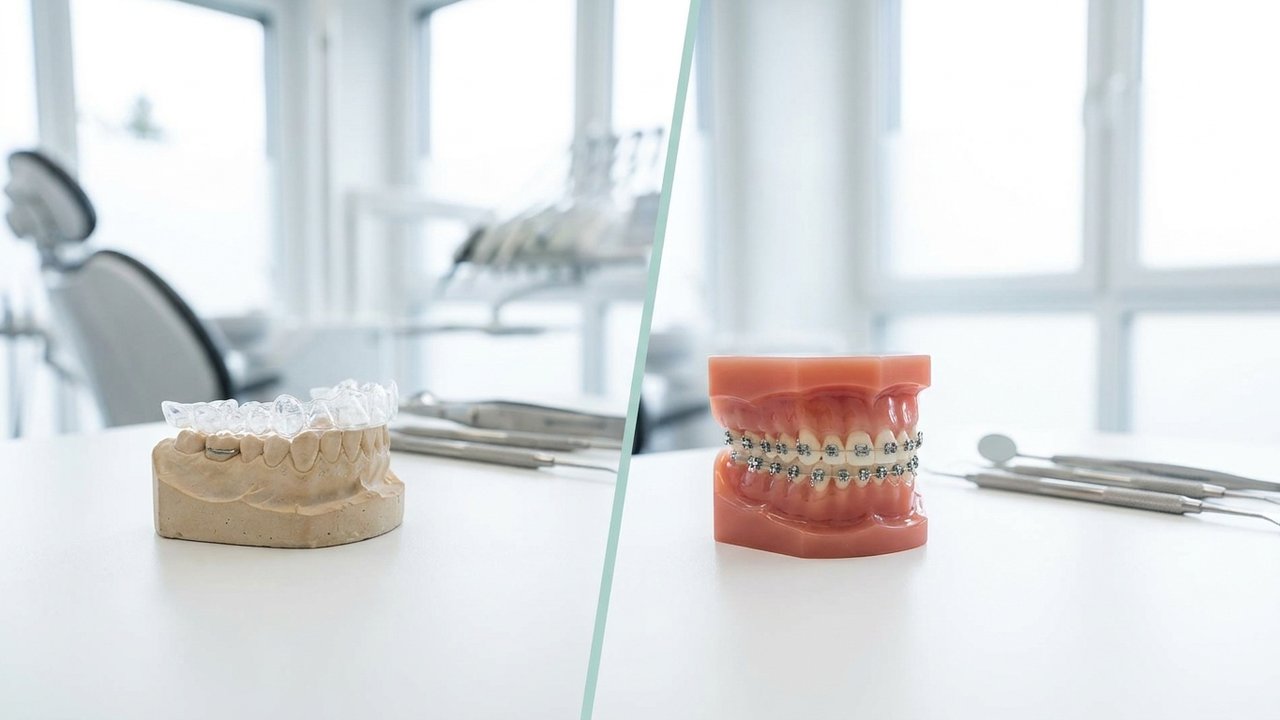
TL;DR: Invisalign and traditional braces can both straighten teeth effectively, and the best choice depends on your case, not just preference. Braces tend to handle the most complex bite and rotation problems and are often a bit cheaper, while Invisalign is removable, more discreet, and usually more comfortable for mild to moderate cases. The American Association of Orthodontists notes that either option can produce excellent results when guided by a trained provider, so the right answer comes from an evaluation of your specific teeth.
Choosing between clear aligners and metal braces is one of the most common decisions in orthodontics. Here is how the two compare on the things patients ask about most: results, comfort, speed, and cost.
How Invisalign and braces work differently
Braces use brackets bonded to your teeth and a wire that is tightened over time to move them. Invisalign uses a series of clear, removable aligners that are swapped out every week or two, each one nudging your teeth a little closer to their final position.
What that means day to day
Braces stay on until your provider removes them, so there is nothing to lose or forget. Invisalign comes out for meals, brushing, and special occasions, which many adults prefer, but only works if you actually wear the aligners the required number of hours each day.

Is Invisalign or braces better?
Neither is universally better. The right choice depends on how complex your case is, your lifestyle, and how disciplined you can be about wearing aligners. Braces have an edge for severe crowding, large gaps, and complicated bite problems, while Invisalign is often the better fit for mild to moderate cases and patients who want a discreet, removable option.

When Dr. Priya evaluates a patient deciding between the two, we look at the actual movements your teeth need rather than starting from what sounds nicer. As a general and cosmetic dentist trained at NYU with over 10 years of experience, Dr. Priya can tell you honestly when a case is well suited to clear aligners and when braces will give you a more predictable result.
In our West New York office we also factor in your daily routine. Dr. Priya often points out that Invisalign only works as well as your consistency, so for a busy patient who knows they will not wear aligners 20 to 22 hours a day, braces may actually be the smarter pick.
Does Invisalign work as well as braces?
For mild to moderate cases, Invisalign can work just as well as braces and finish with comparable results. For very complex movements, braces still offer more control, which is why a professional evaluation matters more than any blanket comparison you read online.

Is Invisalign faster than braces?
It can be, but not always. Many Invisalign cases finish in about 12 to 18 months, and some simple corrections go faster, while braces commonly run 18 to 24 months or longer for complex cases. Treatment time depends far more on how much your teeth need to move than on which appliance you choose.

What Dr. Priya tells patients hoping for the fastest option is that compliance is the real speed factor with Invisalign. In our West New York office we have seen aligner treatment slow down when patients do not wear them enough, so the timeline we quote assumes you follow the wear schedule. With braces, the appliance is always working because it never comes off.
On comfort, Dr. Priya notes that most patients find Invisalign gentler since there are no brackets or wires to irritate the cheeks and lips, though both options cause some normal pressure and soreness when teeth start moving. We give every patient guidance on managing that so the adjustment period is as easy as possible.
Is Invisalign or braces cheaper?
Traditional metal braces are often slightly cheaper than Invisalign, frequently running around $3,000 to $6,000 in the US, while Invisalign typically falls around $3,000 to $7,000. The gap has narrowed in recent years, and because insurance usually covers both the same way, the out of pocket difference is often smaller than people expect.
Compare your options at Veda Dental Aesthetics in West New York
Find out whether Invisalign or braces fits your smile
The best way to choose is an evaluation of your actual teeth, not a guess. At our West New York office, Dr. Priya will assess your bite, walk you through the real pros and cons for your case, and give you a clear plan and cost. Call (201) 223-4444 or book online today. Hablamos Espanol.