Quick Answer
TL;DR — Dental implants have one of the strongest safety records of any elective surgical procedure in dentistry, with long-term survival rates consistently above 95%.
Yes, dental implants are safe for the vast majority of healthy adults. The titanium material used has been tested in clinical use for over 60 years, first in orthopedic surgery and then in dentistry. The American Academy of Implant Dentistry reports that implants placed by trained clinicians in properly selected patients succeed at rates above 95% over a 10-year period. That figure is supported by decades of peer-reviewed research and makes implants one of the most predictable procedures in modern dentistry.
At Veda Family Dentistry in West New York, Dr. Yoel Santiago uses 3D cone-beam imaging and computer-guided surgical planning to reduce the already-low risk of complications further. He reviews each patient's medical history, imaging, and medications before any surgical work. Safety is not assumed. It is planned for.
This page covers the material science behind implant safety, what the actual complication rates look like, who should exercise caution, and how our protocols at the Bergenline Avenue office are designed to protect every patient we treat.
The Safety Record: What the Data Actually Shows
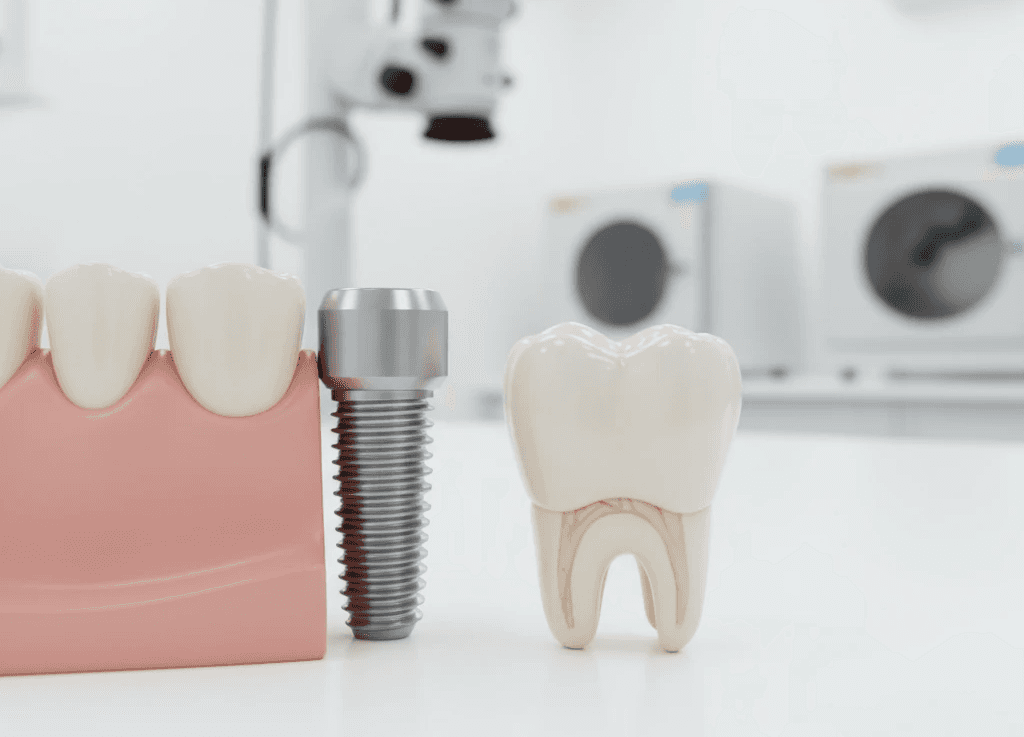
Dental implants use titanium, the same medical-grade alloy used in hip and knee replacements since the 1950s. Titanium is biocompatible, meaning your immune system does not recognize it as foreign and does not attack it. This allows the bone to grow directly onto the implant surface in a process called osseointegration, creating a bond that is mechanical and biological at the same time. No adhesive, no cement holding it to surrounding teeth. Just bone fused to metal.
The American Academy of Implant Dentistry consistently cites long-term survival rates above 95% for implants placed in healthy patients by trained clinicians. That number holds across dozens of independent longitudinal studies. For context, root canals on posterior teeth have a 10-year survival rate in the 85 to 90% range. Tooth-supported bridges typically need replacement within 10 to 15 years. Implants outperform both alternatives on longevity data.
What Are the Actual Complication Rates?
No surgical procedure carries zero risk. The most common implant complications are minor and treatable:
Peri-implant mucositis (gum inflammation around the implant): reversible with improved hygiene and professional cleaning. This is the implant equivalent of gingivitis.
Peri-implantitis (bone loss around the implant from untreated inflammation): less common, typically linked to poor home care, smoking, or uncontrolled diabetes. Caught early at routine check-ups, it is manageable.
Failed osseointegration: the implant does not bond to the bone. This occurs in roughly 1 to 5% of cases, more often in smokers or patients with uncontrolled metabolic conditions. If it happens, the implant is removed, the site heals, and a new implant can usually be placed successfully.
Infection at the surgical site: rare when sterile protocol is followed and patients complete the prescribed antibiotic course.
In our West New York practice, we typically see complication rates well below the national average, which we attribute to thorough pre-surgical screening and the 3D-guided placement protocol Dr. Santiago follows on every case.
How 3D Imaging Makes Implants Safer
One of the most significant advances in implant safety over the past decade is cone-beam computed tomography (CBCT). Before 3D imaging, surgeons relied on 2D panoramic X-rays that do not show bone depth, sinus proximity, or nerve position with precision. Dr. Yoel Santiago uses CBCT on every implant case, which allows him to map the inferior alveolar nerve, the maxillary sinuses, and bone density with sub-millimeter accuracy. The implant position is planned digitally before a single incision is made, and a surgical guide transfers that plan directly to your anatomy during the procedure. Our patients benefit from a level of precision that was simply not available 15 years ago.

Who Should Be Cautious About Dental Implants
Implants are safe for most adults, but certain health conditions require careful evaluation before proceeding. Being in any of these categories does not automatically disqualify you. It means the pre-surgical review needs to be more thorough.
Medical Conditions That Require Evaluation
Uncontrolled diabetes. High blood glucose impairs healing and increases the risk of infection and failed osseointegration. Patients with well-controlled diabetes routinely succeed with implants. The key word is controlled. We request a recent HbA1c result from all diabetic patients before proceeding.
Bisphosphonate use. Medications for osteoporosis (like alendronate or zoledronic acid) can affect bone metabolism. Oral bisphosphonates at low doses carry a low risk of a rare condition called osteonecrosis of the jaw. Intravenous bisphosphonates at high doses carry a higher risk and may be a contraindication to implants. Dr. Santiago reviews all medications at your consultation.
Active smoking. Tobacco use roughly doubles the risk of implant failure by reducing blood flow to the healing site and impairing immune response. We do not refuse smokers, but we counsel every smoking patient on the elevated risk and strongly encourage cessation before surgery.
Autoimmune conditions and immunosuppressants. Conditions or medications that suppress the immune system can slow healing. Each case is reviewed individually.
Radiation to the head or neck. Prior radiation therapy can damage the blood vessels that supply the jaw, affecting healing capacity. A consultation with the treating oncologist is part of our pre-surgical protocol for these patients.
Age and Implant Safety
Implants are generally not placed in patients who have not yet finished jaw development, typically under 18 for most individuals. At the other end of the age range, there is no upper limit. Many of our West New York patients in their 70s and 80s have had successful implant placements. Overall health, bone quality, and good hygiene habits matter far more than age alone.
The Allergy Question: Is Titanium Allergy Real?
True titanium allergy is exceedingly rare, affecting an estimated fraction of a percent of the population. The American Dental Association recognizes titanium as one of the safest implant materials available. For patients who are concerned, zirconia (ceramic) implants are an alternative that our office can discuss. Zirconia implants have a shorter track record than titanium but are metal-free and biocompatible.
Our Safety Protocol at Veda Family Dentistry
Every implant patient at our practice goes through a standardized pre-surgical review that covers medical history, a complete medication list (including supplements and over-the-counter medications), CBCT imaging, a periodontal assessment to confirm gum health, and a blood pressure check on the day of surgery. Dr. Santiago discusses the risks and benefits specific to your case before you sign any consent, and we never pressure patients to proceed on a timeline that does not work for them. That standard applies to every procedure we offer, from a single implant to a full-arch restoration.
Ready to get an honest safety evaluation for implants?
If you are considering dental implants in West New York or Hudson County and want to know whether you are a good candidate from a safety standpoint, Dr. Yoel Santiago would be glad to review your health history and imaging at a no-pressure consultation. We accept most major insurance plans and offer CareCredit and in-house financing for procedures insurance does not cover.
Book your consultation on Zocdoc or call us at (201) 559-0807. Our office is at 5405 Bergenline Ave, Suite 1, West New York, NJ.